
Knowledge and Perception of Nursing Informatics among Staff Nurses at Rumailah Hospital, Doha, Qatar: A Cross-Sectional Study
DOI:
https://doi.org/10.63950/gshh.2026.2.2.55Keywords:
Nursing informatics, Health knowledge, Attitudes, Practice, Cross-sectional study, Qatar, NursesAbstract
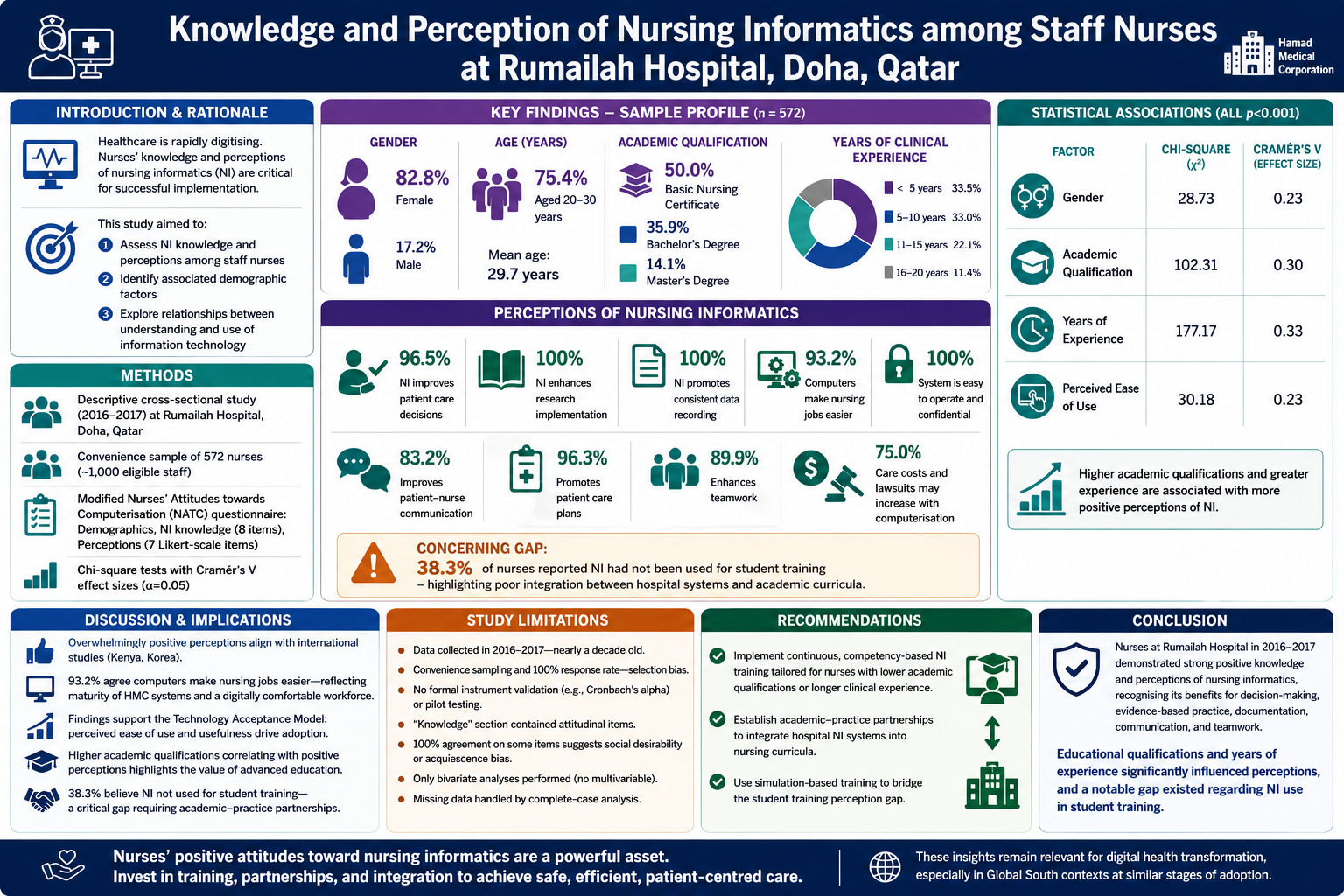
Introduction: Global healthcare digitalisation requires nurses to embrace nursing informatics (NI). This study assessed NI knowledge and perceptions among staff nurses at Rumailah Hospital, Doha, Qatar.
Methods: A descriptive cross‑sectional study was conducted using convenience sampling. A modified Nurses’ Attitudes towards Computerisation (NATC) questionnaire captured demographics, NI knowledge, and perceptions. Chi‑square tests (with Cramér’s V effect sizes) examined associations (alpha = 0.05). Data were collected in 2016‑2017.
Results: Of 572 nurses (82.8% female, 75.4% aged 20‑30 years), 50% held a basic nursing certificate. Positive perceptions were high: 96.5% agreed NI improved care decisions; 100% agreed NI enhanced research implementation and consistent data recording. However, 38.3% noted NI was not used for student training. Significant associations with perception (p<0.001) were found for gender (χ²=28.73, V=0.23), academic qualification (χ²=102.31, V=0.30), years of experience (χ²=177.17, V=0.33), and ease of use understanding (χ²=30.18, V=0.23).
Conclusion: Nurses demonstrated strong positive NI knowledge and perceptions. Despite the age of the dataset, findings highlight enduring needs: targeted education for less‑qualified and more experienced nurses, and integration of NI into student training. These insights remain relevant for digital health transformation in Global South contexts.
Downloads
References
1. Ajibade BL, Oladeji MO, Okunlade JO. Knowledge and attitude towards the introduction of informatics to nursing training among selected nurse educators/leaders in Nigeria. J Dent Med Sci. 2013;9(5):1-7. https://doi.org/10.9790/0853-0950107
2. Newbold S, Klein JO, Douglas JV. Nursing informatics education: past, present and future. In: Hannah KJ, Ball MJ, Edwards MJA, editors. Introduction to nursing informatics. New York: Springer; 2005.
3. Gerdin U, Tallberg M, Wainwright P. The impact of nursing knowledge on health care informatics. In: Nursing informatics. Amsterdam: IOS Press; 1997.
4. Burger A, Blignaut P. A computer literacy course may initially be detrimental to students’ attitudes toward computers. In: ACM International Conference Proceeding Series; 2004;75.
5. Kivuti L, Chepchirchir A. Computerization readiness. Online J Nurs Inform. 2011;15(1):1-11.
6. American Nurses Association (ANA). Nursing informatics: scope and standards of practice. 2nd ed. Silver Spring (MD): ANA; 2015.
7. Guenther JT, Peters M. Mapping the literature of nursing informatics. J Med Libr Assoc. 2006;94(2 Suppl):E92-8.
8. Darvish A, Bahramnezhad F, Keyhanian S, Navidhamidi M. The role of nursing informatics on promoting quality of health care and the need for appropriate education. Glob J Health Sci. 2014;6(6):11-8. https://doi.org/10.5539/gjhs.v6n6p11
9. Curran C. What is informatics? [Internet]. Columbia University; 2001 [cited 2017 Feb 14]. Available from: https://www.columbia.edu/
10. Kipturgo MK, Kivuti-Bitok LW, Karani AK, Muiva MM. Attitudes of nursing staff towards computerisation: a case of two hospitals in Nairobi, Kenya. BMC Med Inform Decis Mak. 2014;14:35. https://doi.org/10.1186/1472-6947-14-35
11. Brodt A, Stronge J. Nurses' attitudes toward computerization in a Midwestern Community Hospital. Comput Nurs. 1986;4:82-6.
12. Shoham S, Gonen A. Intentions of hospital nurses to work with computers: based on the theory of planned behavior. Comput Inform Nurs. 2008;26(2):106-16. https://doi.org/10.1097/01.NCN.0000304777.48155.e3
13. Alquraini H, Alhashem AM, Shah MA, Chowdhury RI. Factors influencing nurses' attitudes towards the use of computerised health information systems in Kuwaiti hospitals. J Adv Nurs. 2007;57(4):375-81. https://doi.org/10.1111/j.1365-2648.2007.04113.x
14. Hamad Medical Corporation. Rumailah Hospital overview [Internet]. Doha (Qatar): HMC; c2016 [cited 2017 Jan 15]. Available from: https://www.hamad.qa/EN/Hospitals-and-services/Rumailah-Hospital/Pages/default.aspx
15. Lee A. The role of informatics in nursing. Nursing Made Incredibly Easy. 2014;12(4):55. https://doi.org/10.1097/01.NME.0000450294.60987.00
16. Kahouei M, Baba Mohammadi H, Askari Majdabadi H, Solhi M, Parsania Z, Said Roghani P, et al. Nurses' perceptions of usefulness of nursing information system: a module of electronic medical record for patient care in two university hospitals of Iran. Mater Sociomed. 2014;26(1):30-4. https://doi.org/10.5455/msm.2014.26.30-34
17. Davis FD. Perceived usefulness, perceived ease of use, and user acceptance of information technology. MIS Q. 1989;13(3):319-40. https://doi.org/10.2307/249008
18. Jetté S, Tribble DSC, Gagnon J, Mathieu L. Nursing students' perceptions of their resources toward the development of competencies in nursing informatics. Nurse Educ Today. 2010;30(8):742-6. https://doi.org/10.1016/j.nedt.2010.01.016
Downloads
Published
Data Availability Statement
The datasets generated and analysed during the current study are available from the corresponding author on reasonable request, subject to HMC’s data governance policies.
Issue
Section
License
Copyright (c) 2026 Oyinloye CMA, Olu-Abiodun OO, Adepoju AA

This work is licensed under a Creative Commons Attribution 4.0 International License.