
The Prevalence and Patterns of Suicidal Ideation Among In‑School Adolescents in Ogun State, Nigeria: A mixed-method survey
DOI:
https://doi.org/10.63950/gshh.2026.2.1.42Keywords:
Adolescent, Adolescent Mental Health, Suicide Ideation, Prevalence, Risk Factors, Protective Factors, NigeriaAbstract
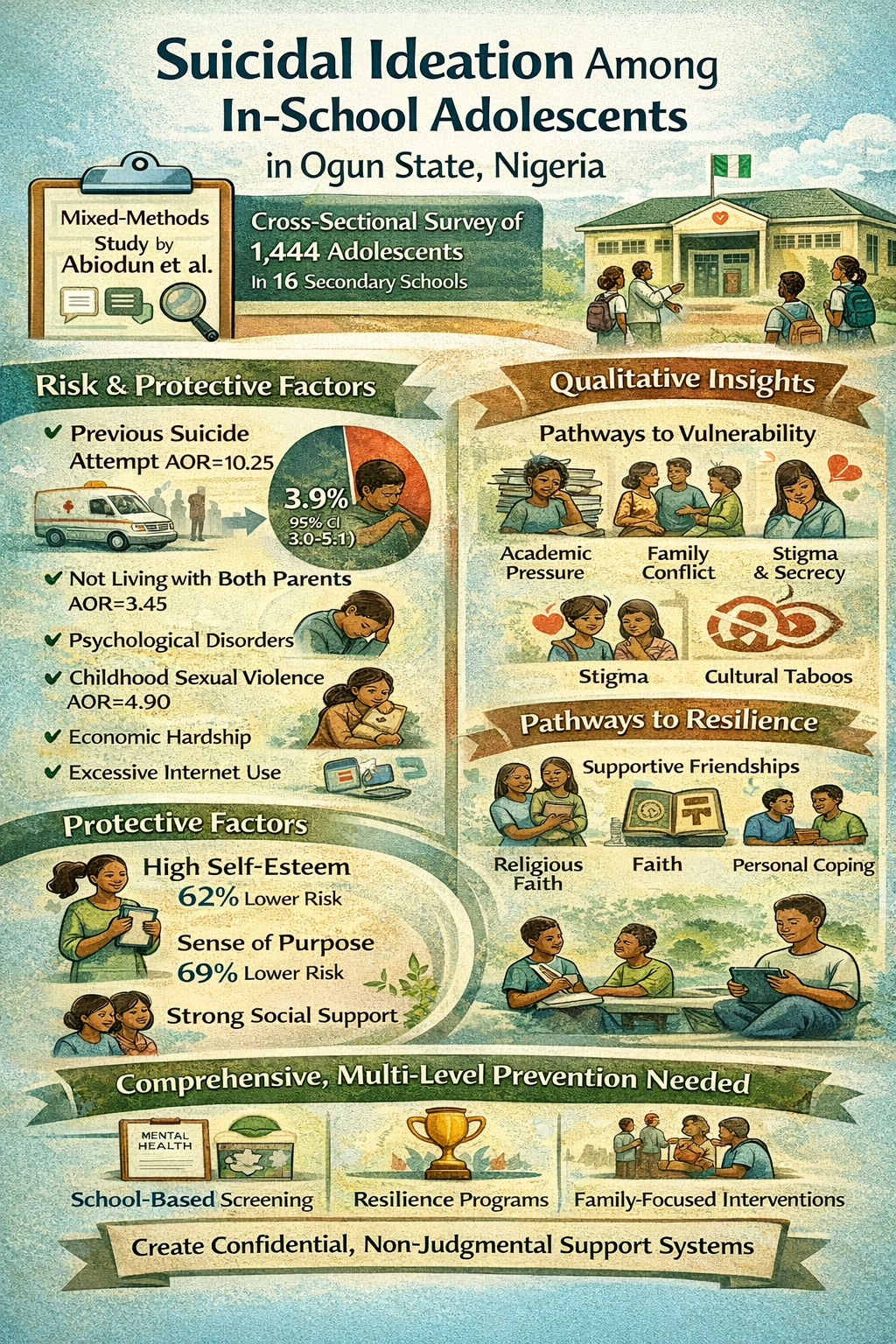
Introduction: This study aimed to determine the prevalence, patterns, and associated factors of suicidal ideation among in-school adolescents in Ogun State, Nigeria.
Methods: A mixed-methods design was employed, comprising a cross-sectional survey of 1,444 adolescents aged 10–19 years from 16 secondary schools, and qualitative in-depth interviews with eight adolescents reporting suicidal ideation and their parents. Data were collected using structured questionnaires. Quantitative data were analysed using descriptive statistics, bivariate tests, and multivariate logistic regression; qualitative data were analysed thematically.
Results: The prevalence of suicidal ideation was 3.9% (95% CI: 3.0–5.1). Mid-adolescents (14–16 years) and those in Senior Secondary Schools had significantly higher odds of suicidal ideation. Key risk factors included previous suicide attempts, living without both parents, psychological disorders (attention deficit, conduct disorder, PTSD, eating disorders), economic hardship, excessive internet use, family instability, childhood sexual violence, and insomnia. Protective factors included high self-esteem, strong social support, a sense of purpose in life, agreeableness, emotional stability, openness, grit, and self-care coping strategies. Thematic analysis of interviews highlighted the lived experiences of adolescents, revealing the role of stigma, secrecy, and cultural taboos surrounding mental health, as well as the protective roles of supportive relationships, religious faith, and personal coping strategies.
Conclusion: Suicidal ideation among in-school adolescents in Ogun State is influenced by a complex interplay of individual, interpersonal, and socio-economic factors. School-based mental health screening, resilience-building programs, and family-focused interventions are recommended to mitigate risk and promote protective factors.
Downloads
References
1. World Health Organization. Mental health of adolescents [Internet]. 2021. Available from: https://www.who.int/news-room/fact-sheets/detail/adolescent-mental-health
2. Klonsky ED, May AM, Saffer BY. Suicide, suicide attempts, and suicidal ideation. Annu Rev Clin Psychol. 2016;12:307–30. https://doi.org/10.1146/annurev-clinpsy-021815-093204
3. Riaz Uddin M, Mamun MA, Rahman MA. Suicidal ideation among adolescents in low- and middle-income countries: a meta-analysis. J Affect Disord. 2019;254:257–65.
4. McKinnon B, Gariepy G, Sentenac M, Elgar FJ. Adolescent suicidal behaviours in 32 low- and middle-income countries. Bull World Health Organ. 2016;94(5):340–50. https://doi.org/10.2471/BLT.15.163295
5. Adewuya AO, Oladipo EO. Prevalence and associated factors for suicidal behaviours among adolescents in Lagos, Nigeria. J Adolesc. 2019;76:99–107.
6. Omigbodun OO, Dogra N, Esan O, Adedokun B. Prevalence and correlates of suicidal behaviour among adolescents in southwest Nigeria. Int J Soc Psychiatry. 2008;54(1):34–46. https://doi.org/10.1177/0020764007078360
7. Patton GC, Sawyer SM, Santelli JS, Ross DA, Afifi R, Allen NB, et al. Our future: a Lancet commission on adolescent health and wellbeing. Lancet. 2016;387(10036):2423–78. https://doi.org/10.1016/S0140-6736(16)00579-1
8. Franklin JC, Ribeiro JD, Fox KR, Bentley KH, Kleiman EM, Huang X, et al. Risk factors for suicidal thoughts and behaviors: a meta-analysis of 50 years of research. Psychol Bull. 2017;143(2):187–232. https://doi.org/10.1037/bul0000084
9. Cramer RJ, Kapusta ND. A social-ecological framework of theory, assessment, and prevention of suicide. Front Psychol. 2017;8:1756. https://doi.org/10.3389/fpsyg.2017.01756
10. Mann JJ, Michel CA, Auerbach RP. Improving suicide prevention through evidence-based strategies: a systematic review. Am J Psychiatry. 2021;178(7):611–24. https://doi.org/10.1176/appi.ajp.2020.20060864
11. Naghavi M, Global Burden of Disease Self-Harm Collaborators. Global, regional, and national burden of suicide mortality 1990 to 2016: systematic analysis for the Global Burden of Disease Study 2016. BMJ. 2019;364:l94. https://doi.org/10.1136/bmj.l94
12. Twenge JM, Joiner TE, Rogers ML, Martin GN. Increases in depressive symptoms, suicide-related outcomes, and suicide rates among U.S. adolescents after 2010 and links to increased new media screen time. Clin Psychol Sci. 2018;6(1):3–17. https://doi.org/10.1177/2167702617723376
13. Kleiman EM, Adams LM, Kashdan TB, Riskind JH. Gratitude and grit indirectly reduce risk of suicidal ideations by enhancing meaning in life: evidence for a mediated moderation model. J Res Pers. 2013;47(5):539–46. https://doi.org/10.1016/j.jrp.2013.04.007
Downloads
Published
Data Availability Statement
The datasets used and analysed during the current study are available from the corresponding author on reasonable request.
Issue
Section
License
Copyright (c) 2026 Abiodun O, Lowery Wilson M, Torty C, Agbor IE (Author)

This work is licensed under a Creative Commons Attribution 4.0 International License.