
Effect of educational intervention on uptake of pain assessment tool among physiotherapists in Low- and Middle-Income Countries - A scoping review
DOI:
https://doi.org/10.63950/gshh.2026.2.1.25Abstract
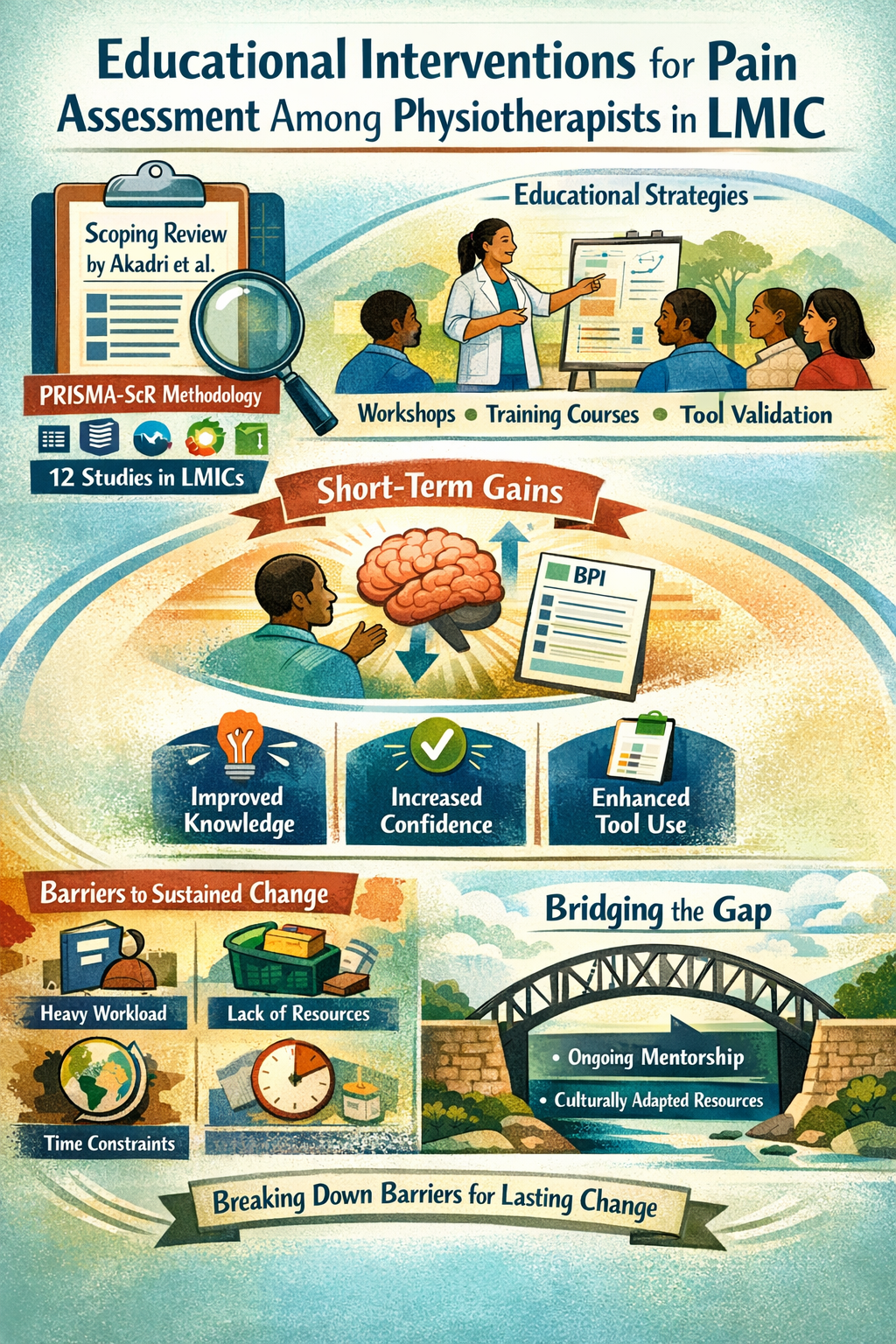
Introduction: High-quality physiotherapy care depends on the regular use of standardised pain assessment instruments, but this remains a major challenge in Low- and Middle-Income Countries (LMICs). Educational interventions are a crucial tactic to increase adoption, yet their effectiveness in these settings is not well synthesised. The purpose of this scoping review is to synthesise existing studies on educational interventions on the use of pain assessment instruments among physiotherapists in LMIC to enhance patient care.
Methods: The review was conducted following the Preferred Reporting Items for Systematic Reviews and Meta-Analyses extension for Scoping Reviews (PRISMA-ScR) guidelines. A systematic search of four electronic databases was performed for studies published between 2015 and May 2025. Twelve studies from LMIC, primarily in Sub-Saharan Africa, met the inclusion criteria.
Synthesis: The review suggests that physiotherapists' knowledge, confidence, and frequency of tool usage improved in the short term because of educational interventions, such as workshops, training courses, and tool-validation projects. Improved test scores and more use of instruments like the Brief Pain Inventory (BPI) were important results. Significant obstacles, such as heavy clinical workloads, time constraints, a lack of resources, and the cultural inadequacy of many of the technologies now in use, prevented widespread adoption. There was little information on long-term practice change in the evidence base, which was mostly composed of short-term trials.
Conclusion: Although educational initiatives can increase physiotherapists in LMIC short-term adoption of pain assessment techniques, removing systemic impediments is necessary for their long-term effectiveness. To encourage consistent evidence-based practice, future programs should incorporate ongoing mentoring and create culturally appropriate resources.
Downloads
References
1. Muhammad TK, Muhammad FS, Muhammad HS, MS. Current role of physiotherapy in response to changing healthcare needs of the society. Int J Educ Inf Technol. 2015;1(3):105–10. Available from: http://www.aiscience.org/journal/ijeit
2. Jiang Y, Wang Y, Wang R, Zhang X, Wang X. Differences in pain, disability, and psychological function in low back pain patients with and without anxiety. Front Physiol. 2022;13:906461. https://doi.org/10.3389/fphys.2022.906461
3. Farooq J, Asif M, Rajput HI, Khan MA, Chughtai MRB, Issani NA. Physiotherapists' approach regarding spasticity measurement scales in patients with upper motor neurone syndrome. Khyber Med Univ J. 2020;12(2):117–20. https://doi.org/10.35845/kmuj.2020.18679
4. Mbada CE, Onigbinde O, Oyewole O, Binuyo T, Gebrye T, Egwu M, Karstens S, Fatoye F. Professional practice profile, treatment preferences, and the bases for clinical, educational, and research among Nigerian physiotherapists. Bull Fac Phys Ther. 2023;28(1):45. https://doi.org/10.1186/s43161-023-00159-2
5. Arntz A, Weber F, Handgraaf M, Lällä K, Korniloff K, Murtonen KP, Chichaeva J, Kidritsch A, Heller M, Sakellari E, Athanasopoulou C, Lagiou A, Tzonichaki I, Salinas-Bueno I, Martínez-Bueso P, Velasco-Roldán O, Schulz RJ. Technologies in home-based digital rehabilitation: Scoping review. JMIR Rehabil Assist Technol. 2023;10:e43615 https://doi.org/10.2196/43615
6. Odole AC, Oyewole OO, Akinpelu AO. A comparative survey of Nigerian physiotherapists' familiarity with, knowledge of, and utilization of standard outcome measures: 10 years after initial survey. S Afr J Physiother. 2018;74(1):435. https://doi.org/10.4102/sajp.v74i1.435
7. Culduz M. Benefits and challenges of e-learning, online education, and distance learning. In: E-learning and Distance Education. 2024. p. 1–24
8. Bernhardsson S, Larsson A, Bergenheim A, Ho-Henriksson CM, Ekhammar A, Lange E, Larsson MEH, Nordeman L, Samsson KS, Bornhöft L. Digital physiotherapy assessment vs. conventional face-to-face physiotherapy assessment of patients with musculoskeletal disorders: A systematic review. PLoS One. 2023;18(3):e0283013. https://doi.org/10.1371/journal.pone.0283013
9. Kowalski CP, Kawentel LM, Kyriakides TC, Davis L, Bowersox NW, Kilbourne AM, Huang GD, Nevedal AL. Facilitating future implementation and translation to clinical practice: the Implementation Planning Assessment Tool for Clinical Trials. J Clin Transl Sci. 2022;6(1):e467. https://doi.org/10.1017/cts.2022.467
10. Hong QN, Pluye P, Fàbregues S, Bartlett G, Boardman F, Cargo M, et al. Mixed methods appraisal tool (MMAT), version 2018. Registration of copyright. 2018;1148552(10):1–7.
11. Ampiah PK, Hendrick P, Moffatt F, Ampiah JA. A physiotherapist-led biopsychosocial education and exercise programme for patients with chronic low back pain in Ghana: a mixed-methods feasibility study. BMC Musculoskelet Disord. 2024;25(1):1014.
12. Morriss WW, Roques CJ. Pain management in low-and middle-income countries. BJA Education. 2018;18(9), 265-270. https://doi.org/10.1016/j.bjae.2018.05.006
13. da Silva VA, Galhardoni R, Teixeira MJ, de Andrade DC. Not just a matter of pain intensity: effects of three different conditioning stimuli on conditioned pain modulation effects. Neurophysiologie Clinique. 2018 Oct 1;48(5):287-93.
14. Sawadogo A, Sogbossi ES, Everard GJ, Kpadonou T, Batcho CS. Use of standardised outcome measures among physiotherapists in French-speaking sub-Saharan Africa. S Afr J Physiother. 2024;80(1):1981.
15. da Silva Ranzatto AD, Chaves TC, Martins MN, Motta DP, Nogueira LC, Meziat-Filho N, Reis FJ. Pain intensity scales: A cross-sectional study on the preferences and knowledge of physiotherapists and participants with musculoskeletal pain. Musculoskelet Sci Pract. 2024;73:103162.
16. Nkhoma KB, Mwalabu GT, Bristowe K, Lungu EA, Harding R. Stakeholders' perspectives and requirements on pain self-management for adolescents living with HIV/AIDS in Malawi: a cross-sectional qualitative study. AIDS Care. 2023;35(8):1125–38.
17. Naidoo V, Stewart AV, Maleka ME. A tool to evaluate physiotherapy clinical education in South Africa. S Afr J Physiother. 2022;78(1):1759.
18. Kiyange F, Atieno M, Luyirika EB, Ali Z, Musau H, Thambo L, et al. Measuring palliative care integration in Malawi through service provision, access, and training indicators: the Waterloo Coalition Initiative. BMC Palliat Care. 2024;23(1):17.
19. Myezwa H, Nixon S, Potterton J, Ajidahun AT, Cameron C, Konje M, et al. Evaluation of a knowledge translation intervention for HIV and rehabilitation advocacy in physiotherapy in three sub-Saharan African countries. Disabil Rehabil. 2024;46(6):1220–9.
20. Saracoglu I, Aksoy CC, Afsar E, Arik MI. Does pain neuroscience education improve pain knowledge, beliefs and attitudes in undergraduate physiotherapy students? Physiother Res Int. 2021;26(2):e1898.
21. Siddiqui AS, Ahmed A, Rehman A, Afshan G. Pain assessment in intensive care units of a low-middle income country: impact of the basic educational course. BMC Med Educ. 2023;23(1):567.
22. Tunpattu S, Newey V, Sigera C, De Silva P, Goonarathna A, Aluthge I, et al. A short, structured skills training course for critical care physiotherapists in a lower-middle-income country. Physiother Theory Pract. 2018;34(9):714–22.
23. Chung JYS, Li WHC, Cheung AT, Ho LLK, Chung JOK. Efficacy of a blended learning programme in enhancing the communication skill competence and self-efficacy of nursing students in conducting clinical handovers: a randomised controlled trial. BMC Med Educ. 2022;22(1):275 https://doi.org/10.1186/s12909-022-03361-3 .
24. Dubovi AS, Sheu HB. Testing the effectiveness of an SCT-based training program in enhancing health self-efficacy and outcome expectations among college peer educators. J Couns Psychol. 2022;69(3):361 https://psycnet.apa.org/doi/10.1037/cou0000592 .
25. Msoka EF, Orina F, Sanga ES, Miheso B, Mwanyonga S, Meme H, et al. Qualitative assessment of the impact of socioeconomic and cultural barriers on uptake and utilisation of tuberculosis diagnostic and treatment tools in East Africa: a cross-sectional study. BMJ Open. 2021;11(7):e050911 https://doi.org/10.1136/bmjopen-2021-050911
26. Reddy B, Thomas S, Karachiwala B, Sadhu R, Iyer A, Sen G, et al. A scoping review of the impact of organisational factors on providers and related interventions in LMIC: implications for respectful maternity care. PLOS Glob Public Health. 2022;2(10):e0001134 https://doi.org/10.1371/journal.pgph.0001134
27. Sarikhani Y, Najibi SM, Razavi Z. Key barriers to the provision and utilization of maternal health services in low- and lower-middle-income countries: a scoping review. BMC Women's Health. 2024;24(1):325 https://doi.org/10.1186/s12905-024-03177-x
28. Swinkels RAHM, Meerhoff GM, Custers JWH, van Peppen RPS, Beurskens AJHM, Wittink H. Using outcome measures in daily practice: development and evaluation of an implementation strategy for physiotherapists in the Netherlands. Physiother Can. 2015;67(4):357–64 https://doi.org/10.3138/ptc.2014-28
29. International Association for the Study of Pain. Pain Management Education in Low- and Middle-Income Settings [Internet]. International Association for the Study of Pain (IASP); 2025 Aug 26 [cited 2025 Sep 24]. Available from: https://www.iasp-pain.org/resources/fact-sheets/pain-management-education-in-low-and-middle-income-settings/
Downloads
Published
Data Availability Statement
No primary data were generated or analysed in this study. All data supporting the findings of this scoping review are available in the published literature cited within the article.
Issue
Section
License
Copyright (c) 2026 Akadri OM, Lawal SA, Akadri AA (Author)

This work is licensed under a Creative Commons Attribution 4.0 International License.