
Diagnostic Value of Anti‑HpNAP and Anti‑UreB IgG as Non‑Invasive Serological Markers in Active Helicobacter pylori Infection
DOI:
https://doi.org/10.63950/gshh.2025.1.2.31Keywords:
Helicobacter pylori; HpNAP (Helicobacter pylori neutrophil-activating protein); Urease B subunit (UreB); Serological biomarkers; Stool antigen test, Helicobacter pylori, HpNAP, UreB, Serologic markers, Stool antigen testAbstract
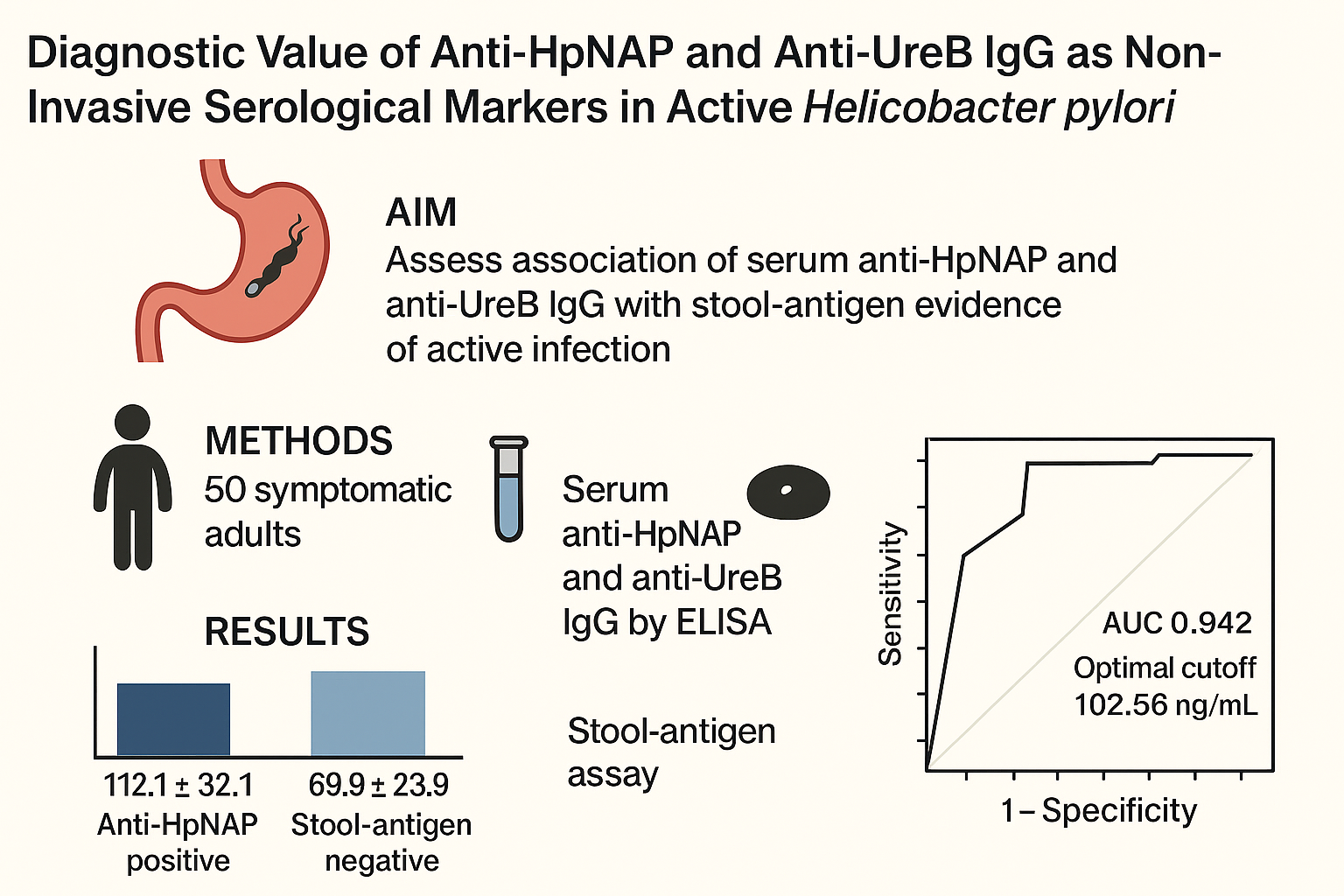
Introduction: Accurate non-invasive markers of active Helicobacter pylori infection are needed. This study measured serum anti-HpNAP and anti-UreB IgG in symptomatic adults and compared levels between stool-antigen-positive and negative patients.
Methods: Cross-sectional study of 50 adults (30 HpSA-positive, 20 HpSA-negative). Anti-HpNAP and anti-UreB IgG were measured by ELISA. Group comparisons used Welch's t-test. Receiver operating characteristic (ROC) analysis and logistic regression were performed.
Results: Mean anti-HpNAP IgG: 112.1 ± 32.1 ng/mL (HpSA-positive) vs 69.9 ± 23.9 ng/mL (HpSA-negative); Welch t = 5.321, df = 47.3, p < 0.0001. Mean anti-UreB IgG: 153.9 ± 50.1 ng/mL vs 102.0 ± 40.8 ng/mL; Welch t = 4.017, df = 46.0, p = 0.0003. AUC (HpNAP) = 0.942; optimal cutoff = 102.56 ng/mL (sensitivity = 0.77, specificity = 0.95). AUC (UreB) = 0.803; optimal cutoff = 112.83 ng/mL (sensitivity = 0.80, specificity = 0.75). Univariable logistic regression OR per 1 ng/mL increase: HpNAP = 1.105 (95% CI 1.041–1.173), UreB = 1.030 (95% CI 1.011–1.050).
Conclusion: Serum anti‑HpNAP and anti‑UreB IgG concentrations are significantly higher in patients with stool‑antigen evidence of active H. pylori infection. These antigen‑specific serologic markers warrant further validation (including ROC analysis and longitudinal assessment) to determine their diagnostic performance and potential clinical roles.
Downloads
References
1. Malfertheiner P, Camargo MC, El-Omar E, Liou JM, Peek R, Schulz C, Smith SI, Suerbaum S. Helicobacter pylori infection. Nature reviews Disease primers. 2023 Apr 20;9(1):19. https://doi.org/10.1038/s41572-023-00431-8
2. Malfertheiner P, Mégraud F, O'Morain CA, Gisbert JP, Kuipers EJ, Axon AT, Bazzoli F, Gasbarrini A, Atherton J, Graham DY, Hunt R. Management of Helicobacter pylori infection—the Maastricht V/Florence consensus report. Gut. 2017 Jan 1;66(1):6-30. https://doi.org/10.1136/gutjnl-2016-312288
3. Tay ACY, Marshall B. Helicobacter pylori interpretation in 2022. Gut Microbiota and Integrative Wellness. 2022;1. https://doi.org/10.54844/gmiw.2022.0089
4. Kao CY, Sheu BS, Wu JJ. Helicobacter pylori infection: An overview of bacterial virulence factors and pathogenesis. Biomed J. 2016;39(1):14-23. https://doi.org/10.1016/j.bj.2015.06.002
5. Shakir SM, Shakir FA, Couturier MR. Updates to the diagnosis and clinical management of Helicobacter pylori infections. Clin Chem. 2023;69(8):869-880. https://doi.org/10.1093/clinchem/hvad081
6. Sousa C, Ferreira R, Santos SB, Azevedo NF, Melo LD. Advances on diagnosis of Helicobacter pylori infections. Crit Rev Microbiol. 2023;49(6):671-692. https://doi.org/10.1080/1040841X.2022.2125287
7. Ricci C, Holton J, Vaira D. Diagnosis of Helicobacter pylori: invasive and non‑invasive tests. Best Pract Res Clin Gastroenterol. 2007;21(2):299-313. https://doi.org/10.1016/j.bpg.2006.11.002
8. Liao G, Gong J, Zhao L, Hou J, Zheng H, Li Y, Wu Y, Chen B. Urease Breath Test and Stool Antigen Test Diagnose Helicobacter Pylori Infection in Patients with Bleeding Peptic Ulcer: a Meta‑analysis. Chin Gen Pract. 2022;25(3):354.
9. Li ZX, Bronny K, Formichella L, Mejías-Luque R, Burrell T, Macke L, Lang U, Vasapolli R, Hysenaj O, Stallforth I, Vieth M. A multiserological line assay to potentially discriminate current from past Helicobacter pylori infection. Clinical Microbiology and Infection. 2024 Jan 1;30(1):114-21. https://doi.org/10.1016/j.cmi.2023.10.006
10. Zhang Z, Chen X, Li B, Xia T, Wu X, Wu C. Helicobacter pylori induces urease subunit B‐specific CD8+ T cell responses in infected individuals via cytosolic pathway of cross‐presentation. Helicobacter. 2023 Oct;28(5):e13005. https://doi.org/10.1111/hel.13005
11. Fu HW. Helicobacter pylori neutrophil‑activating protein: from molecular pathogenesis to clinical applications. World J Gastroenterol. 2014;20(18):5294-5306. https://doi.org/10.3748/wjg.v20.i18.5294
12. Fu HW, Lai YC. The role of Helicobacter pylori neutrophil‑activating protein in the pathogenesis of H. pylori and beyond. Int J Mol Sci. 2022;24(1):91. https://doi.org/10.3390/ijms24010091
13. Codolo G, Coletta S, D'Elios MM, de Bernard M. HP‑NAP of Helicobacter pylori: The Power of Immunomodulation. Front Immunol. 2022;13:944139. https://doi.org/10.3389/fimmu.2022.944139
14. Mobley H. The role of Helicobacter pylori urease in the pathogenesis of gastritis and peptic ulceration. Aliment Pharmacol Ther. 1996;10(Suppl 1):57-64. https://doi.org/10.1046/j.1365-2036.1996.22164006.x
15. Donati M, Moreno S, Storni E, Tucci A, Poli L, Mazzoni C, Varoli O, Sambri V, Farencena A, Cevenini R. Detection of serum antibodies to CagA and VacA and of serum neutralizing activity for vacuolating cytotoxin in patients with Helicobacter pylori-induced gastritis. Clinical Diagnostic Laboratory Immunology. 1997 Jul;4(4):478-82. https://doi.org/10.1128/cdli.4.4.478-482.1997
16. Ekesbo R, Toth E, Fork FT, Held M, Nilsson I, Wadström T, Sjölund K. Chronic Helicobacter pylori infection in a population in southern Sweden analysed by histopathology, immunoblot and ELISA serology. European journal of gastroenterology & hepatology. 2006 Jun 1;18(6):589-93. https://doi.org/10.1097/00042737-200606000-00003
17. Zalabska E. Does the authentication of the antibodies against Helicobacter pylori have contribution to its diagnosis? Klin Mikrobiol Infekc Lek. 2011;17(1):33-37.
18. Reynders MB, Deyi VY, Dahma H, Scheper T, Hanke M, Decolvenaer M, Dediste A. Performance of individual Helicobacter pylori antigens in the immunoblot-based detection of H. pylori infection. FEMS Immunology & Medical Microbiology. 2012 Apr 1;64(3):352-63. https://doi.org/10.1111/j.1574-695X.2011.00920.x
19. Al Ofairi BA, Saeed MK, Al-Qubaty M, Abdulkareem AM, Al-Jahrani MA. Diagnostic value of IgG antibody and stool antigen tests for chronic Helicobacter pylori infections in Ibb Governorate, Yemen. Scientific Reports. 2024 Mar 29;14(1):7536. https://doi.org/10.1038/s41598-024-58165-w
20. Kajihara Y, Shimoyama T, Mizuki I. Evaluation of the effects of a proton pump inhibitor on Helicobacter pylori stool antigen testing. Helicobacter. 2023;28(3):e12961. https://doi.org/10.1111/hel.12961
21. Khorsheed SA. A Comparative Study of Serological and Stool Antigen Tests for Helicobacter pylori Infection Diagnosis. J Angiother. 2024;8(4):1-6. https://doi.org/10.25163/angiotherapy.849578
Downloads
Published
Data Availability Statement
The datasets used and/or analysed during the current study are available from the corresponding author on reasonable request.
Issue
Section
License
Copyright (c) 2025 Hassan MA (Author)

This work is licensed under a Creative Commons Attribution 4.0 International License.