
Hand hygiene promotion system assessment in a long-term care facility in Qatar: a cross-sectional evaluation using the WHO Self-Assessment Framework
DOI:
https://doi.org/10.63950/gshh.2026.2.2.54Keywords:
Hand hygiene, Guideline adherence, Long-term care, Patient safety, QatarAbstract
Introduction: Healthcare-associated infections cause substantial morbidity. Hand hygiene is the most effective preventive measure, but compliance is suboptimal, especially in long-term care. We assessed the hand hygiene promotion system at a long-term care facility in Qatar using a validated WHO tool, focusing on system readiness rather than directly observed compliance.
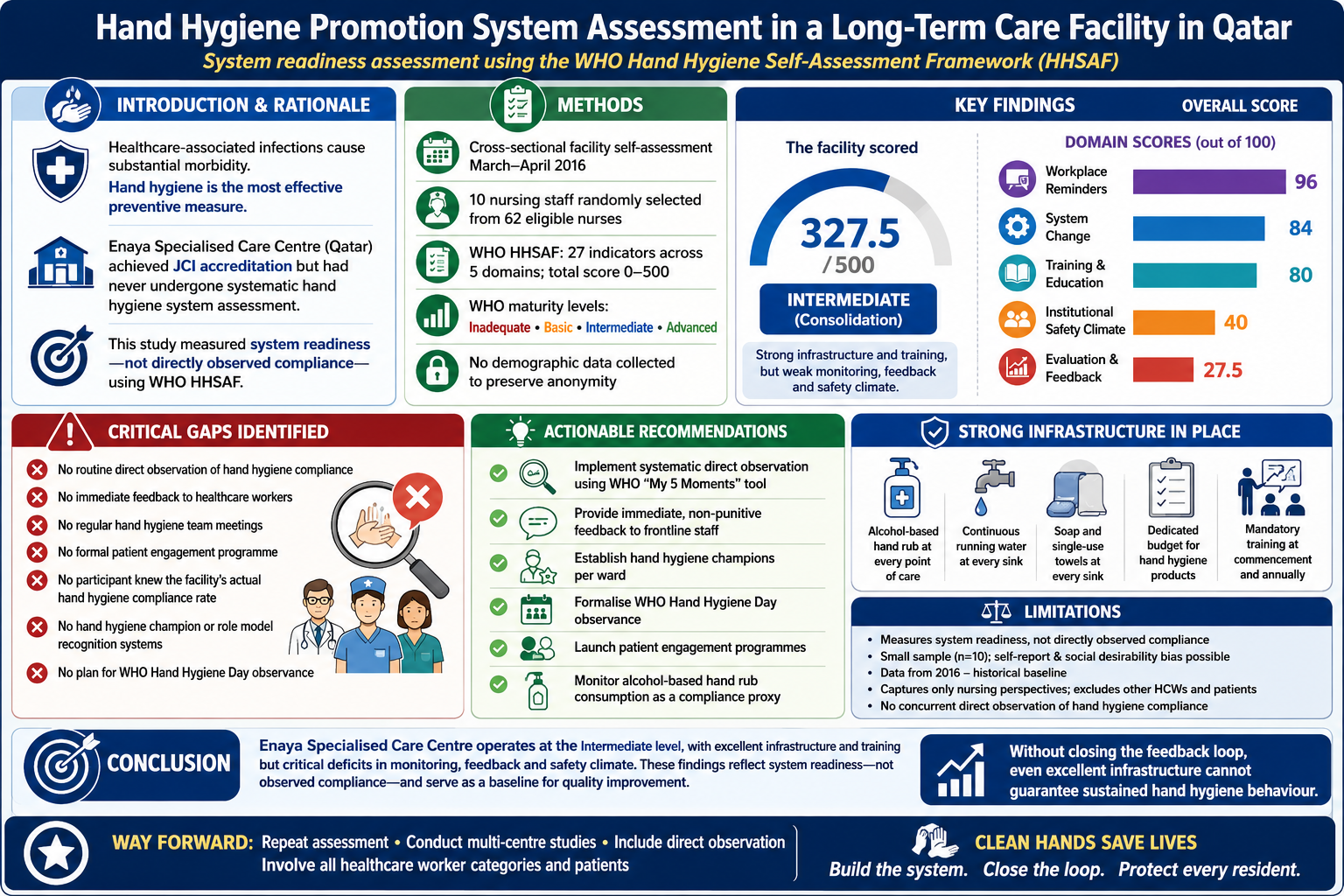
Methods: A cross-sectional facility self-assessment was conducted (March–April 2016) at Enaya Specialised Care Centre, Hamad Medical Corporation, Doha. Ten nursing staff were randomly selected to complete the WHO Hand Hygiene Self-Assessment Framework (27 indicators, five domains: System Change, Training and Education, Evaluation and Feedback, Workplace Reminders, Institutional Safety Climate). Descriptive statistics were used; total scores (0–500) were categorised into four WHO levels (Inadequate, Basic, Intermediate, and Advanced).
Results: The facility scored 327.5/500 – Intermediate (Consolidation) level. Domain scores: Workplace Reminders 96/100, System Change 84/100, Training and Education 80/100, Safety Climate 40/100, Evaluation and Feedback 27.5/100. All participants reported irregular direct observation, no immediate feedback to healthcare workers, no regular hand hygiene team meetings, and no formal patient engagement programme. No participant knew the facility’s actual hand hygiene compliance rate.
Conclusion: The facility has strong infrastructure, mandatory training, and visual reminders, achieving an Intermediate system level. However, major gaps exist in monitoring, feedback, and safety climate – areas that measure actual behavioural reinforcement, not just infrastructure. Priority actions include routine direct observation, real-time feedback, hand hygiene champions, and formal WHO Day observance. These findings reflect system readiness, not observed compliance, and should be interpreted as a baseline for quality improvement.
Downloads
References
1. Allegranzi B, Pittet D. Role of hand hygiene in healthcare‑associated infection prevention. J Hosp Infect. 2009;73(4):305-15. https://doi.org/10.1016/j.jhin.2009.04.019
2. Pittet D, Allegranzi B, Sax H, et al. Evidence‑based model for hand transmission during patient care and the role of improved practices. Lancet Infect Dis. 2006;6(10):641-52. https://doi.org/10.1016/S1473-3099(06)70600-4
3. Akyol A, Ulusoy H, Ozen I. Handwashing: a simple, economical and effective method for preventing nosocomial infections in intensive care units. J Hosp Infect. 2006;62(4):395-405. https://doi.org/10.1016/j.jhin.2005.10.007
4. Boyce JM, Pittet D. Guideline for hand hygiene in health‑care settings: recommendations of the Healthcare Infection Control Practices Advisory Committee and the HICPAC/SHEA/APIC/IDSA Hand Hygiene Task Force. Infect Control Hosp Epidemiol. 2002;23(Suppl):S3-40. https://doi.org/10.1086/503164
5. World Health Organization. WHO guidelines on hand hygiene in health care. Geneva: WHO Press; 2009.
6. Gould DJ, Moralejo D, Drey N, Chudleigh JH. Interventions to improve hand hygiene compliance in patient care. Cochrane Database Syst Rev. 2017;9(9):CD005186. https://doi.org/10.1002/14651858.CD005186.pub4
7. Smith A, Bouchoucha S, Hutchinson A. Hand hygiene compliance in long‑term care facilities: a systematic review. Am J Infect Control. 2021;49(6):813-20.
8. The Peninsula. Hamad Medical Corporation holds campaign to promote hand hygiene. 4 Aug 2013. Available from: https://www.thepeninsulaqatar.com/ (accessed 2026).
9. Khan FY, Elshafie SS, Almaslamani M, et al. Epidemiology of bacteraemia in Hamad General Hospital, Qatar: a one-year hospital‑based study. Travel Med Infect Dis. 2010;8(6):377-87. https://doi.org/10.1016/j.tmaid.2010.10.004
10. Joint Commission International. Accreditation standards for long-term care. 1st ed. Oak Brook (IL): JCI; 2012.
11. World Health Organization. Hand Hygiene Self‑Assessment Framework 2010. Geneva: WHO Press; 2010.
12. Reigle V. 5 steps to improving regulatory compliance and quality at your hospital. Chicago: Clinical Colleagues, Inc.; 2013.
13. Stewardson AJ, Allegranzi B, Sax H, et al. Testing the WHO Hand Hygiene Self‑Assessment Framework for usability and reliability. J Hosp Infect. 2013;83(1):30-5. https://doi.org/10.1016/j.jhin.2012.05.017
14. Al‑Jumaili AA, Al‑Rekabi MD, Al‑Sorori M. Hand hygiene knowledge, attitudes, and practices among healthcare workers in a tertiary care hospital in Saudi Arabia. J Infect Public Health. 2020;13(10):1479-84.
15. Michie S, van Stralen MM, West R. The behaviour change wheel: a new method for characterising and designing behaviour change interventions. Implement Sci. 2011;6:42. https://doi.org/10.1186/1748-5908-6-42
16. Storr J, Twyman A, Zingg W, et al. Core components for effective infection prevention and control programmes: new WHO evidence‑based recommendations. Antimicrob Resist Infect Control. 2017;6:6. https://doi.org/10.1186/s13756-016-0149-9
Downloads
Additional Files
Published
Data Availability Statement
The anonymised dataset generated and analysed during the current study is available from the corresponding author on reasonable request.
Issue
Section
License
Copyright (c) 2026 Oyinloye CMA, Olu-Abiodun OO, Adepoju AA

This work is licensed under a Creative Commons Attribution 4.0 International License.