
Contraceptive Use and Determinants Among Women Living with HIV in Ijebu Ode, Ogun State, Nigeria
DOI:
https://doi.org/10.63950/gshh.2025.1.2.14Keywords:
Contraceptive use, Women living with HIV, HIV status disclosure, Antiretroviral therapy, NigeriaAbstract
Introduction: Women living with HIV (WLHIV) face a heightened risk of unintended pregnancies, which can lead to mother-to-child transmission of HIV. Ensuring access to effective contraceptive methods is essential for protecting maternal and child health. This study assessed the prevalence of contraceptive use and associated factors among WLHIV in Ijebu Ode Local Government Area, Ogun State, Nigeria.
Methods: A descriptive cross-sectional study was conducted among 144 WLHIV aged 18–49 years, selected using simple random sampling from the PEPFAR clinic at the State Hospital, Ijebu Ode. Data were collected using a structured, interviewer-administered questionnaire covering demographics, contraceptive use, perceptions, and influencing factors. Descriptive statistics and chi-square tests were used to analyse the data.
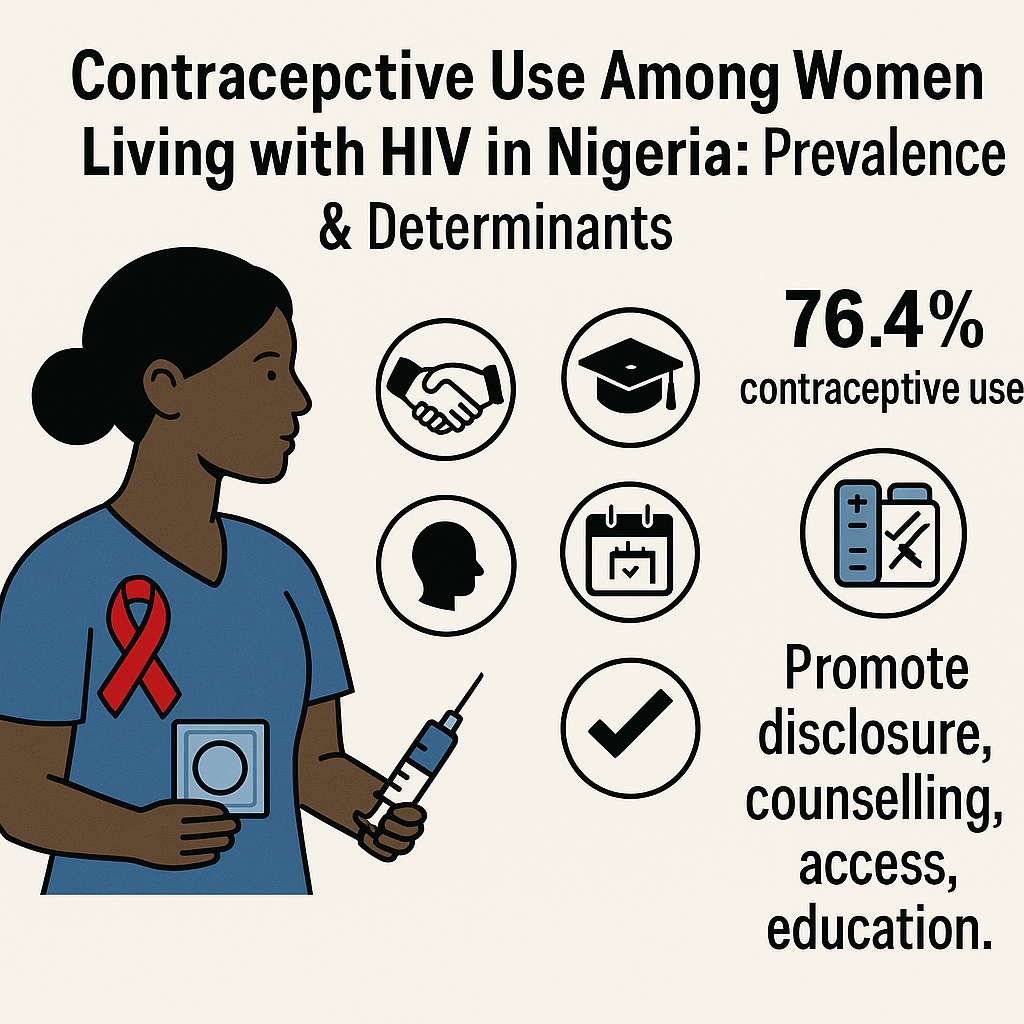
Results: Contraceptive use prevalence among participants was 76.4%. The most used methods were condoms (83.3%) and injectables (41.8%). Contraceptive use was significantly associated with HIV status disclosure to a partner (p = 0.025), prior counselling on contraceptives (p = 0.001), tertiary education (p = 0.026), access to preferred methods (p = 0.001), and lack of desire for more children (p = 0.020). The belief that contraceptives interfere with antiretroviral therapy (ART) was negatively associated with use (p < 0.001).
Conclusion: Contraceptive uptake among WLHIV in this setting was high, particularly among women who had disclosed their HIV status, received counselling, or attained higher education. Interventions that promote disclosure, integrate family planning into HIV care, and address ART-contraceptive misconceptions are crucial for improving reproductive health outcomes.
Downloads
References
1. Alemu L, Enawgaw L, Yimer T, Muluneh AG. Contraceptive use and associated factors among women seeking induced abortion in Debre Marko’s Town, Northwest Ethiopia: a cross-sectional study. Reprod Health. 2020;17(1). https://doi.org/10.1186/s12978-020
2. Alo OD, Daini BO, Omisile OK, Adeleye AO, Idowu AO, Adebayo SB. Factors influencing the use of modern contraceptive in Nigeria: a multilevel logistic analysis using linked data from Performance Monitoring and Accountability 2020. BMC Womens Health. 2020;20:191. https://doi.org/10.1186/s12905-020-01059-6
3. Nigeria HIV/AIDS Indicator and Impact Survey (NAIIS). 2019.
4. Amsalu M, Worku K, Ayalew M, Alamneh AA. Contraceptive use and associated factors among women of reproductive age on antiretroviral therapy in Awabel Woreda health centers, Northwest Ethiopia. SAGE Open Med. 2023;11:20503121231190275. https://doi.org/10.1177/20503121231190275
5. UNAIDS. Press Release. 2019 Mar 14 [cited 2025 Jul 18]. Available from: https://www.unaids.org/en/resources/presscentre/pressreleaseandstatementarchive/2019/march/20190314_nigeria
6. Bongomin F, Chelangat I, Odiit A, Siedner MJ, Atim P. Prevalence and factors associated with contraceptive use among HIV-infected women of reproductive age attending infectious disease clinic at Gulu Regional Referral Hospital, Northern Uganda. Biomed Res Int. 2018;2018:9680514. https://doi.org/10.1155/2018/9680514
7. Gedefaw G, Wondmieneh A, Demis A. Contraceptive use and method preferences among HIV positive women in Ethiopia: a systematic review and meta-analysis. Biomed Res Int. 2020;2020:6465242. https://doi.org/10.1155/2020/6465242
8. Adeleye KK, Ekanem EE, Fasawe O, Dairo M. Reproductive plans and utilization of contraceptives among women living with HIV. Int J MCH AIDS. 2019;8(2):120–130. https://doi.org/10.21106/ijma.277
9. Yaya I, Patassi AA, Landoh DE, Doukoure M, Aboubakari AS, N'dri-Yoman T, et al. Modern contraceptive use among HIV-infected women attending HIV care centres in Togo: a cross-sectional study. BMJ Open. 2018;8:e019006. https://doi.org/10.1136/bmjopen-2017-019006
10. World Health Organization. Family planning/contraception. 2019 [cited 2025 Jul 18]. Available from: https://www.who.int/news-room/fact-sheets/detail/family-planning-contraception.
11. Tewabe T, Getaneh A, Admas M, Zelalem T. Contraceptive use and associated factors among sexually active reproductive age HIV positive women attending ART clinic at Felege Hiwot Referral Hospital, Northwest Ethiopia: a cross-sectional study. Heliyon. 2020;6(12):e05653. https://doi.org/10.1016/j.heliyon.2020.e05653
12. Idris I, Wolday SJ, Mengstu B, Debas T. Contraception use among HIV-positive women attending ART clinic: a cross-sectional study in Halibet Referral Hospital. Glob Reprod Health. 2021;6(3):e55. https://doi.org/10.1097/GRH.0000000000000055
13. Kebede YB, Kebede SA, Tadesse DB. Associated factors of modern contraceptive use among women infected with human immunodeficiency virus in Enemay District, Northwest Ethiopia: a facility-based cross-sectional study. BMC Public Health. 2019;19:28. https://doi.org/10.1186/s12889-019-7675-3
14. Berhane Y, Berhe H, Abera GB, Berhe H. Utilization of modern contraceptives among HIV positive reproductive age women in Tigray, Ethiopia: a cross-sectional study. ISRN AIDS. 2013;2013:319724. https://doi.org/10.1155/2013/319724
15. Lumor DA, Obirikorang C, Acheampong E, Obirikorang Y, Owusu H, Newton S. The relevance of knowledge, perception, and factors that influence contraceptive use among married women living in Uaddara Barracks, Ghana. Front Glob Womens Health. 2023. https://doi.org/10.3389/fgwh.2023.1110024
16. Adenuga FA, Oduola T, Oladokun RE. Contraceptive use among women living with HIV and AIDS receiving care at secondary and tertiary health care facilities in Ibadan. Am J Clin Exp Med. 2019;5(6):218–223. Available from: https://www.researchgate.net/publication/349338482.
17. Melaku YA, Zeleke EG. Contraceptive utilization and associated factors among HIV positive women on chronic follow up care in Tigray Region, Northern Ethiopia: a cross-sectional study. PLoS One. 2014;9(4):e94682. https://doi.org/10.1371/journal.pone.0094682
18. Sodeinde K, Osinaike O, Adeniyi-Ebiesuwa A, Oduye A, Ajayi E, Akande B, Ige-Edaba E, Odusanya K, Ogunmoye A, Orafu E, Oyedepo E. Contraceptive Utilization and Perceived Spousal Involvement among Female Employees of Child-bearing Age in a Private University in Ogun State, Nigeria: Utilization and Perceived Spousal Involvement in Contraceptive. Babcock University Medical Journal. 2024 Jun 30;7(1):1-0. https://doi.org/10.38029/babcockuniv.med.j..v7i1.328
19. Samson T, Omoyajowo A, Adeleke O. Contraceptive use and its associated factors in Nigeria: Evidence from during and after COVID-19. Babcock University Medical Journal. 2025 Jul 15;8(1):348-55. https://doi.org/10.38029/babcockuniv.med.j..v8i1.718
Downloads
Published
Data Availability Statement
Available upon request.
Issue
Section
License
Copyright (c) 2025 Olu-Abiodun OO, Sodimu O, Ilusanmi O, Sagbo F (Author)

This work is licensed under a Creative Commons Attribution 4.0 International License.