
Knowledge and Prevention of Anaemia in Pregnancy among Pregnant Women attending Antenatal Clinic at Oba Ademola II Maternity Hospital, Ijemo, Ogun State, Nigeria
DOI:
https://doi.org/10.63950/gshh.2026.2.1.29Keywords:
Anaemia in pregnancy, Knowledge, PreventionAbstract
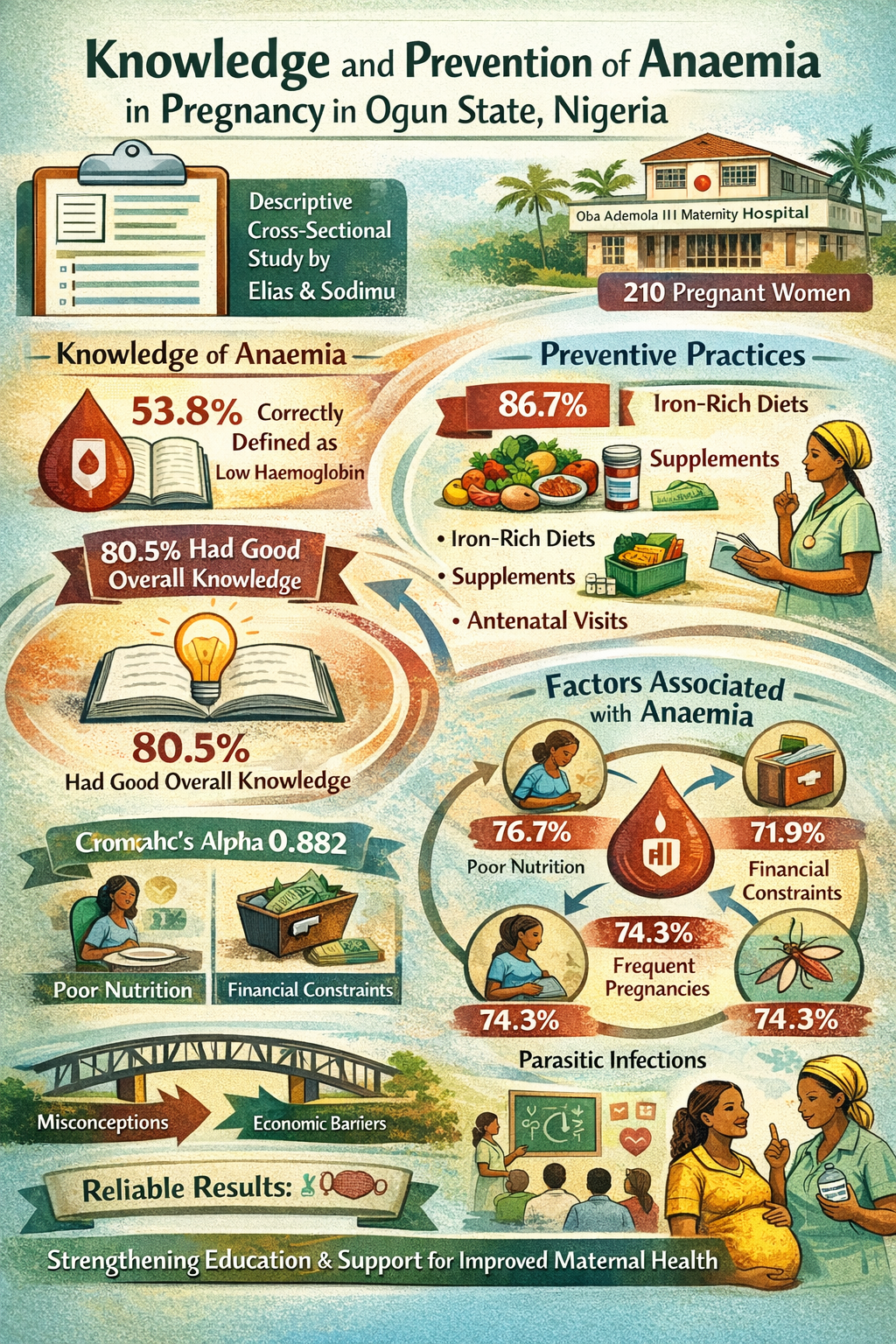
Introduction: Anaemia in pregnancy remains a major global health concern and the most common nutritional disorder affecting women in developing countries. It contributes significantly to maternal and perinatal morbidity and mortality. This study assessed the knowledge and preventive practices regarding anaemia among pregnant women attending the antenatal clinic at Oba Ademola II Maternity Hospital, Ijemo, Ogun State.
Methods: A descriptive cross-sectional design was employed among 210 pregnant women selected using a convenience sampling technique. The sample size was determined using Taro Yamane’s formula. Data were collected with a validated, structured self-administered questionnaire covering socio-demographic characteristics, knowledge, preventive measures, and associated factors. Ethical approval was obtained from the Oba Ademola II Maternity Hospital Research Ethics Committee. Data were analysed using SPSS version 23.0 with descriptive and inferential statistics; significance was set at p ≤ 0.05.
Results: Although only 53.8% correctly defined anaemia as low haemoglobin, 80.5% demonstrated good overall knowledge based on a ≥70% score cut-off. Preventive measures were widely practised, with 86.7% adhering to iron-rich diets, supplements, and regular antenatal visits. Major factors associated with anaemia included poor nutrition (76.7%), financial constraints (71.9%), frequent pregnancies (74.3%), and parasitic infections (74.3%). Knowledge was significantly associated with socio-demographic characteristics (p < 0.05) and preventive practices (p < 0.001). The instrument showed high reliability (Cronbach’s alpha = 0.882).
Conclusion: Although awareness and preventive practices were encouraging, misconceptions and economic barriers persist. Strengthened health education, culturally sensitive counselling, and socioeconomic support are essential to enhance anaemia prevention and improve maternal health outcomes.
Downloads
References
1. Awoyesuku PA, Ohaka C, Ngeri B. Prevalence of anemia in pregnant women under antenatal care at the Rivers State University Teaching Hospital, Port Harcourt, Nigeria and association with knowledge and attitude on anemia and its prevention. Int J Trop Dis Health. 2020;41(20):20–33. https://doi.org/10.9734/ijtdh/2020/v41i2030390
2. World Health Organization. Anaemia in women and children: Key global health observatory data. Geneva: WHO; 2023 [cited 2024 Dec 9]. Available from: https://www.who.int/data/gho/data/themes/topics/anaemia_in_women_and_children
3. Babah OA, Akinajo OR, Beňová L, Hanson C, Abioye AI, Adaramoye VO, et al. Prevalence of and risk factors for iron deficiency among pregnant women with moderate or severe anaemia in Nigeria: a cross-sectional study. BMC Pregnancy Childbirth. 2024;24(1):39. https://doi.org/10.1186/s12884-023-06169-1
4. Ademuyiwa IY, Ayamolowo SJ, Oginni MO, Akinbode MO. Awareness and prevention of anemia among pregnant women attending antenatal clinic at a university teaching hospital in Nigeria. Calabar J Health Sci. 2020;4:20–26. https://doi.org/10.25259/cjhs_22_2020
5. Oyerinde OO, Nkanga EA, Oyerinde IE, Akintoye O, Asekun-Olarinmoye I, Alabi QK. Factors affecting anemia in pregnant women in Ibeju-Lekki, Lagos State, Nigeria. Inquiry J Health Care Organ Provision Financ. 2023;60:1–11. https://doi.org/10.1177/00469580231159961
6. Elias TI, Sodimu JO. Perception and Acceptance of Caesarean Section among Pregnant Women Attending Antenatal Clinic in Oba Ademola Maternity Hospital, Ijemo, Ogun State, Nigeria. (2025). Global South Health Horizons, 1(2), 57-65. https://doi.org/10.63950/gshh.2025.1.2.26
7. Aleboko SO, Abdulai K, Ayensu J, Agyapong NA, Mohammed AS, Nsiah-Asamoah C, et al. Knowledge, attitudes, and practices regarding anaemia among pregnant women attending antenatal clinic at the University of Cape Coast Hospital in the Cape Coast Metropolis, Ghana. Integr Health Res J. 2023;1(2):35–42. https://doi.org/10.47963/ihrj.v1i2.1372
8. Ozoani HA. Assessment of attitude, knowledge and prevention of anemia in pregnancy among women attending antenatal care in Udi LGA, Enugu State, Nigeria. IPS J Public Health. 2024;4(1):96–103. https://doi.org/10.54117/ijph.v4i1.26
9. Alem AZ, Efendi F, McKenna L, Felipe-Dimog EB, Chilot D, Tonapa SI, et al. Prevalence and factors associated with anemia in women of reproductive age across low- and middle-income countries based on national data. Sci Rep. 2023;13(1):1–11. https://doi.org/10.1038/s41598-023-46739-z
10. Balcha WF, Eteffa T, Tesfu AA, Alemayehu BA, Chekole FA, Ayenew AA, et al. Factors associated with anemia among pregnant women attending antenatal care: a health facility-based cross-sectional study. Ann Med Surg. 2023;85(5):1712–1721. https://doi.org/10.1097/ms9.0000000000000608
Downloads
Published
Data Availability Statement
The data supporting the findings of this study are available from the corresponding author upon reasonable request.
Issue
Section
License
Copyright (c) 2026 Elias TI, Sodimu JO (Author)

This work is licensed under a Creative Commons Attribution 4.0 International License.