
The Role of Selected Inflammatory and Apoptotic Markers in Peptic Ulcer Disease: A Mini Review
DOI:
https://doi.org/10.63950/gshh.2026.2.2.24Keywords:
Peptic ulcer, Inflammatory markers, Apoptotic markers, Helicobacter pylori, CaspasesAbstract
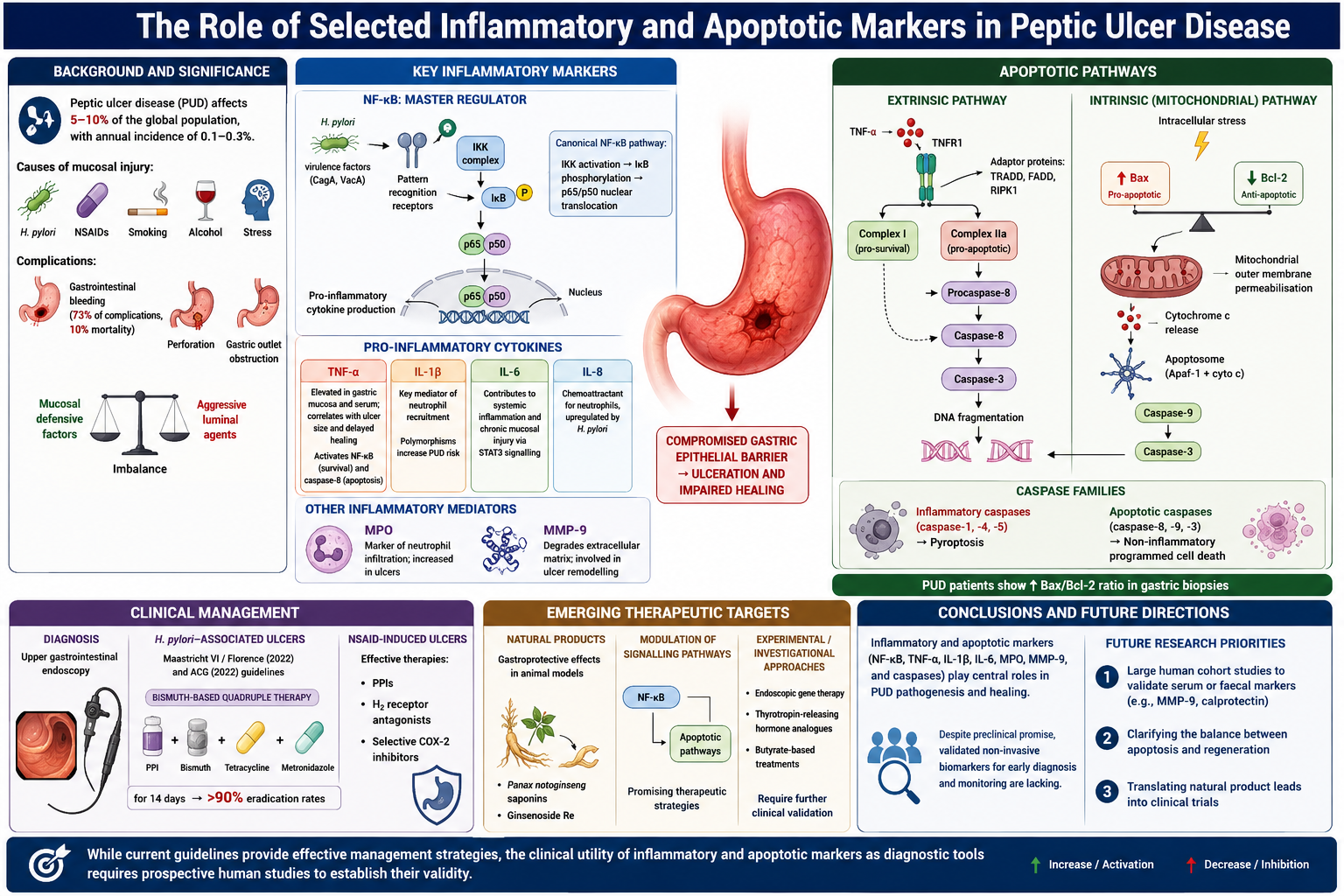
Introduction: Peptic ulcer disease (PUD) affects 5–10% of the global population and results from mucosal injury caused by gastric acid, Helicobacter pylori, non-steroidal anti-inflammatory drugs (NSAIDs), and other factors. Inflammatory and apoptotic pathways are central to PUD pathogenesis.
Methods: This mini review synthesised literature from PubMed, Google Scholar, and Web of Science (2000 - 2025) using keywords “peptic ulcer,” “inflammatory markers,” “apoptotic markers,” “NF κB,” and “caspases.” Studies reporting molecular mechanisms in human or animal models were included.
Synthesis: Reactive oxygen species activate NF κB, leading to pro-inflammatory cytokines (IL 1β, IL 6, TNF α) that perpetuate mucosal injury. Inflammatory caspases (caspase 1, 4, 5) drive pyroptosis, while apoptotic caspases (caspase 8, 9, 3) regulate epithelial cell death. Key markers include NF κB, TNF α, IL 6, Bax, and Bcl 2. Current guidelines (Maastricht VI/ACG 2022) recommend bismuth-based quadruple therapy for H. pylori, achieving >90% eradication. However, human validation for most biomarkers remains limited.
Conclusion: Inflammatory and apoptotic markers are promising therapeutic targets and potential diagnostic tools, but prospective human studies are needed to establish their clinical utility.
Downloads
References
1. Adebodun GO, Odunaike DO, Olajide LO, Adebodun AS, Kayode AAA. Review of some ethnomedicinal remedies for peptic ulcer. FFS. 2023;3(11):258-74. https://doi.org/10.31989/ffs.v3i11.1246
2. Narayanan M, Reddy KM, Marsicano E. Peptic ulcer disease and Helicobacter pylori infection. Mo Med. 2018;115(3):219-24.
3. Lanas A, García-Rodríguez LA, Polo-Tomás M, Ponce M, Quintero E, Perez-Aisa MA, et al. The changing face of hospitalisation due to gastrointestinal bleeding and perforation. Aliment Pharmacol Ther. 2011;33(5):585-91. https://doi.org/10.1111/j.1365-2036.2010.04563.x
4. Kayode AAA, Adeola SM, Olanrewaju MJ. Antiulcerogenic activity of eight chromatographic fractions of ethyl acetate leaf extracts of Securidaca longepedunculata Fres. (Polygalaceae) and Luffa cylindrica (L.) Roem. (Cucurbitaceae). Orient J Chem. 2020;36(1):100-5. https://doi.org/10.13005/ojc/360113
5. Kowada A, Asaka M. Economic and health impacts of Helicobacter pylori eradication strategy for the treatment of peptic ulcer disease: a cost-effectiveness analysis. Helicobacter. 2022;27(3):e12886. https://doi.org/10.1111/hel.12886
6. Gurusamy KS, Pallari E. Medical versus surgical treatment for refractory or recurrent peptic ulcer. Cochrane Database Syst Rev. 2016;3(3):CD011523. https://doi.org/10.1002/14651858.CD011523.pub2
7. Kayode AAA, Lawal BA, Abdullahi AA, Sonibare MA, Moody JO. Medicinal plants used in the treatment of gastric ulcer in Southwestern and North Central Nigeria. J Med Plants Res. 2019;13(4):119-28. https://doi.org/10.3923/rjmp.2019.119.128
8. Chey WD, Leontiadis GI, Howden CW, Moss SF. ACG clinical guideline: treatment of Helicobacter pylori infection. Am J Gastroenterol. 2017;112(2):212-39. https://doi.org/10.1038/ajg.2016.563
9. Lanas A, Chan FKL. Peptic ulcer disease. Lancet. 2017;390(10094):613-24. https://doi.org/10.1016/S0140-6736(16)32404-7
10. Strand DS, Kim D, Peura DA. 25 years of proton pump inhibitors: a comprehensive review. Gut Liver. 2017;11(1):27-37. https://doi.org/10.5009/gnl15502
11. Levenstein S, Rosenstock S, Jacobsen RK, Jørgensen T. Psychological stress increases risk for peptic ulcer: a 10 year prospective study of 5,000 Danes. Gut. 2015;64(6):866-73. https://doi.org/10.1136/gutjnl-2014-307170
12. Kayode AAA, Kayode OT, Odetola AA. Anti ulcerogenic activity of two extracts of Parquetina nigrescens and their effects on mucosal antioxidants defence system on ethanol-induced ulcer in rats. Res J Med Plants. 2009;3(3):102-8. https://doi.org/10.3923/rjmp.2009.102.108
13. Olayemi IO, Soremekun OE, Kayode AAA. Gastroprotective effect of ginsenoside Re on ethanol induced ulcer in Wistar rats. Lett Appl NanoBioScience. 2024;13(3):115. https://doi.org/10.33263/LIANBS133.115
14. Rahman Z, Dwivedi DK, Jena GB. Ethanol induced gastric ulcer in rats and intervention of tert butylhydroquinone: involvement of Nrf2/HO 1 signalling pathway. Hum Exp Toxicol. 2020;39(4):547-62. https://doi.org/10.1177/0960327119895559
15. Wroblewski LE, Peek RM Jr. Helicobacter pylori in gastric carcinogenesis: mechanisms. Gastroenterol Clin North Am. 2015;44(3):599-614. https://doi.org/10.1016/j.gtc.2015.05.005
16. Mogensen TH. Pathogen recognition and inflammatory signaling in innate immune defenses. Clin Microbiol Rev. 2009;22(2):240-73. https://doi.org/10.1128/CMR.00046-08
17. Wicherska-Pawłowska K, Wróbel T, Rybka J. Toll like receptors (TLRs), NOD like receptors (NLRs), and RIG I like receptors (RLRs) in innate immunity. Int J Mol Sci. 2021;22(24):13397. https://doi.org/10.3390/ijms222413397
18. Sato S, Sanjo H, Takeda K, Ninomiya-Tsuji J, Yamamoto M, Kawai T, et al. Essential function for the kinase TAK1 in innate and adaptive immune responses. Nat Immunol. 2005;6(11):1087-95. https://doi.org/10.1038/ni1255
19. Konturek PC, Brzozowski T, Konturek SJ, Majka J, Stachura J, Hahn EG. Role of tumour necrosis factor α in the pathogenesis of gastric mucosal damage induced by ischaemia/reperfusion. Eur J Pharmacol. 2001;423(2-3):251-8.
20. Xue Y, Zhou LY, Lin SR, Hou XH, Li ZS, Chen MH, et al. IL 1B gene polymorphisms and risk of peptic ulcer disease: a meta-analysis. J Gastroenterol Hepatol. 2021;36(5):1154-62. https://doi.org/10.1111/jgh.15289
21. Enitan S, Adejumo E, Osakue O, Eke S, Akele R, Edafetanure-Ibeh O, Enitan C. Integrating genomics and proteomics technologies in biological research: Advantages, challenges, and prospects. Global South Health Horizons. 2025 Jun 29;1(1):12-35. https://doi.org/10.63950/gshh.2025.1.1.2
22. Kwiecień S, Brzozowski T, Konturek PC, Konturek SJ. The role of reactive oxygen species and inflammatory mediators in the pathogenesis of gastric mucosal damage. J Physiol Pharmacol. 2002;53(4 Pt 1):519-38.
23. Pender SLF, MacDonald TT. Matrix metalloproteinases and the gut - new roles for old enzymes. Curr Opin Pharmacol. 2004;4(6):546-50. https://doi.org/10.1016/j.coph.2004.06.011
24. Wang L, Du F, Wang X. TNF α induces two distinct caspase 8 activation pathways. Cell. 2008;133(4):693-703. https://doi.org/10.1016/j.cell.2008.03.036
25. Jang DI, Lee AH, Shin HY, Song HR, Park JH, Kang TB, et al. The role of tumour necrosis factor alpha (TNF α) in autoimmune disease and current TNF α inhibitors in therapeutics. Int J Mol Sci. 2021;22(5):2719. https://doi.org/10.3390/ijms22052719
26. Shao Y, Sun K, Xu W, Li XL, Shen H, Sun WH. Helicobacter pylori infection, gastrin and cyclooxygenase 2 in gastric carcinogenesis. World J Gastroenterol. 2014;20(36):12860-73. https://doi.org/10.3748/wjg.v20.i36.12860
27. Jones NL, Shannon PT, Cutz E, Yeger H, Sherman PM. Increased gastric epithelial cell apoptosis in children with Helicobacter pylori infection. Gastroenterology. 2002;122(4):1080-9.
28. Li L, Du Y, Wang Y, He N, Wang B, Zhang T. Atractylone alleviates ethanol induced gastric ulcer in rat with altered gut microbiota and metabolites. J Inflamm Res. 2022;15:4709-23. https://doi.org/10.2147/JIR.S372389
29. Malfertheiner P, Megraud F, Rokkas T, Gisbert JP, Liou JM, Schulz C, et al. Management of Helicobacter pylori infection: the Maastricht VI/Florence consensus report. Gut. 2022;71(9):1724-62. https://doi.org/10.1136/gutjnl-2022-327745
30. Chey WD, Leontiadis GI, Howden CW, Moss SF. ACG clinical guideline: treatment of Helicobacter pylori infection (2022 update). Am J Gastroenterol. 2022;117(12):1907-41. https://doi.org/10.14309/ajg.0000000000002028
31. Sun Q, Liang X, Zheng Q, Liu W, Xiao S, Gu W, et al. High efficacy of 14-day triple therapy-based, bismuth-containing quadruple therapy for initial Helicobacter pylori eradication. Helicobacter. 2010;15(3):233-8. https://doi.org/10.1111/j.1523-5378.2010.00758.x
32. Da Costa DM, Yuan Y, Wagner JS, L'Italien GJ, Lescrauwaet B, Langley P. The burden of viral hepatitis C in Europe: a propensity analysis of patient outcomes. Eur J Gastroenterol Hepatol. 2012;24(8):869-77. https://doi.org/10.1097/MEG.0b013e3283551dee
33. Strand DS, Kim D, Peura DA. 25 years of proton pump inhibitors: a comprehensive review. Gut Liver. 2017;11(1):27-37. https://doi.org/10.5009/gnl15502
34. Kadhm A, Al-Galebi A. Analysis of IL-6 and IL-8 gene polymorphisms and their association with cytokine levels in sinus infections. Babcock University Medical Journal. 2025 Dec 31;8(2):60-75. https://doi.org/10.38029/babcockuniv.med.j..v8i2.961
35. Zhou B, Zhang W, Wu Y, Yang Y, Wang N, Li J, et al. Improved efficacy of Panax notoginseng saponin loaded into BSP/alginate microspheres for the treatment of alcoholic gastric ulcers. Int J Pharm. 2021;596:120218. https://doi.org/10.1016/j.ijpharm.2021.120218
36. Kuna L, Jakab J, Smolic R, Raguz-Lucic N, Vcev A, Smolic M. Peptic ulcer disease: a brief review of conventional therapy and herbal treatment options. J Clin Med. 2019;8(2):179. https://doi.org/10.3390/jcm8020179
Downloads
Published
Data Availability Statement
The data and materials associated with this research will be made available by the corresponding author upon request.
Issue
Section
License
Copyright (c) 2026 Akinola O, Adebayo E, Ogunyemi A, Sangobowale O, Kayode AAA

This work is licensed under a Creative Commons Attribution 4.0 International License.