
Knowledge of Risk Factors and Preventive Practices for Monkeypox among People Living with HIV attending an ART Clinic in Abeokuta, Nigeria
DOI:
https://doi.org/10.63950/gshh.2026.2.2.53Keywords:
Monkeypox, HIV, Knowledge, Preventive practices, NigeriaAbstract
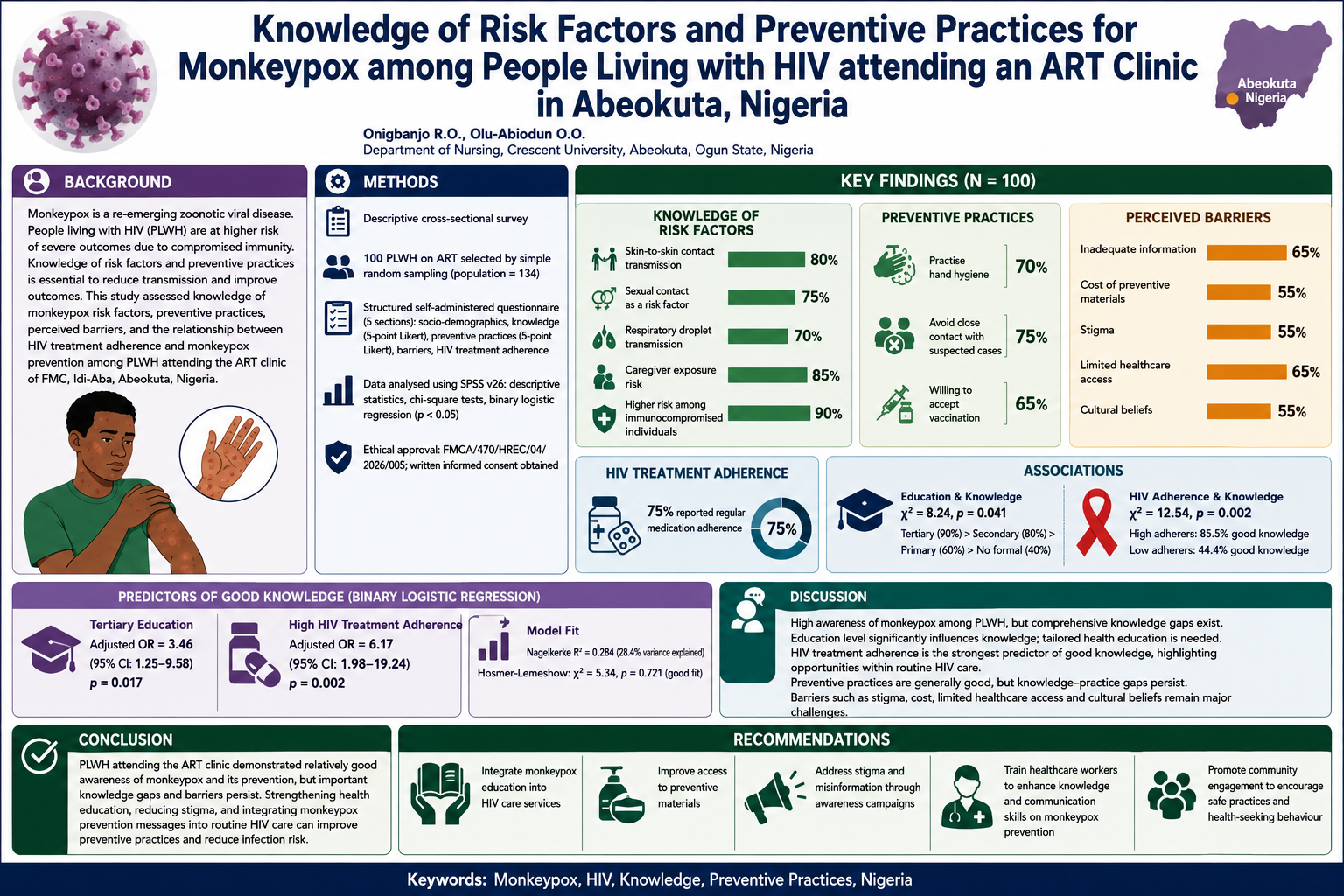
Introduction: Monkeypox is a re-emerging zoonotic viral disease of global public health concern, particularly among people living with HIV who face increased risk of severe outcomes due to compromised immunity. Knowledge of risk factors and preventive practices is essential for reducing transmission and improving health outcomes in this vulnerable population.
Methods: This descriptive cross-sectional study assessed knowledge of monkeypox risk factors, preventive practices, perceived barriers, and HIV treatment adherence among PLWH attending the ART Clinic of the Federal Medical Centre, Idi-Aba, Abeokuta, Nigeria. Using simple random sampling, 100 respondents were selected. Data were collected using a structured questionnaire and analysed using SPSS. Descriptive statistics (frequencies and percentages) were employed, and results were presented in tables.
Results: The findings revealed that 80% of respondents were aware that close skin-to-skin contact can transmit monkeypox, while 90% recognized that immunocompromised individuals are at greater risk of severe infection. Most respondents reported engaging in preventive practices such as regular hand hygiene and avoiding close contact with suspected cases. However, knowledge gaps regarding certain transmission routes were identified. Perceived barriers included inadequate information, stigma, financial constraints, cultural beliefs, and limited access to healthcare. A positive association was observed between HIV treatment adherence and monkeypox knowledge and preventive practices.
Conclusion: Although PLWH attending the ART clinic demonstrated relatively good awareness of monkeypox and its prevention, important knowledge gaps and barriers persist. Strengthening health education, reducing stigma, and integrating monkeypox prevention messages into routine HIV care may improve preventive practices and reduce infection risk among PLWH.
Downloads
References
1. Henderson DA, Moss SW, Ziegler PE. History and global transmission of monkeypox virus. Lancet Infect Dis. 2019;19(7):763-768.
2. Bunge EM, Hoet B, Chen L, Ligon B. Monkeypox outbreak: Clinical characteristics, epidemiology, and public health impact. Int J Epidemiol. 2022;51(5):1243-1253. https://doi.org/10.1093/ije/dyab087
3. Patterson LC, Tan SP, Gould SW. The role of HIV immunocompromise in vulnerability to zoonotic diseases like monkeypox. HIV Clin Trials. 2020;21(5):138-145.
4. Olumide AO, Olatunji SO, Adediran AI. Healthcare access and disease prevention in ART clinic in FMC Idi-Aba, Abeokuta: Challenges and solutions. Afr Health Sci. 2020;20(3):2374-2380. https://doi.org/10.4314/ahs.v20i3.13
5. Junaid AO, Oyeyemi AL, Shittu AM. Stigma and discrimination in HIV care: Implications for disease management and prevention in Sub-Saharan Africa. Int J Public Health. 2021;66(8):1101-1109.
6. Ježek Z, Grab B, Kutin J. Human monkeypox: Clinical features of 282 cases. J Infect Dis. 1987;156(1):1-11. https://doi.org/10.1093/infdis/156.1.1
7. Lawrence A. Knowledge, self-efficacy, and trust: a cross-sectional study on perceptions of monkeypox vaccination and public health risk awareness in Makurdi, Benue State. Cureus. 2024;16:e308568. https://doi.org/10.7759/cureus.72131
8. Abiodun O, Olu-Abiodun O, Faturoti A. Charting a New Course for Global South Health Research: Equity, Evidence, and Action. Global South Health Horizons. 2025 Jun 29;1(1):1-7. https://doi.org/10.63950/gshh.2025.1.1.8
9. Oluwatosin OA, Sodimu O, Ilusanmi O, Sagbo F. Contraceptive Use and Determinants Among Women Living with HIV in Ijebu Ode, Ogun State, Nigeria. Global South Health Horizons. 2025 Oct 30;1(2):8-15. https://doi.org/10.63950/gshh.2025.1.2.14
10. Nuzzo JB, DeYoung K, Paltiel AD. Viral zoonotic infections and people living with HIV: A review of emerging infectious diseases. Glob Health Action. 2021;14(1):1870403.
Downloads
Published
Data Availability Statement
The datasets generated and analysed during the current study are available from the corresponding author upon reasonable request.
Issue
Section
License
Copyright (c) 2026 Onigbanjo RO, Olu-Abiodun OO

This work is licensed under a Creative Commons Attribution 4.0 International License.