
Perception of Artificial Intelligence Interactive Platforms for HIV/AIDS Awareness among Selected Private Secondary School Students in Abeokuta North, Ogun State
DOI:
https://doi.org/10.63950/gshh.2026.2.2.52Keywords:
Artificial intelligence, HIV/AIDS awareness, Secondary school students, Perception, Interactive platformsAbstract
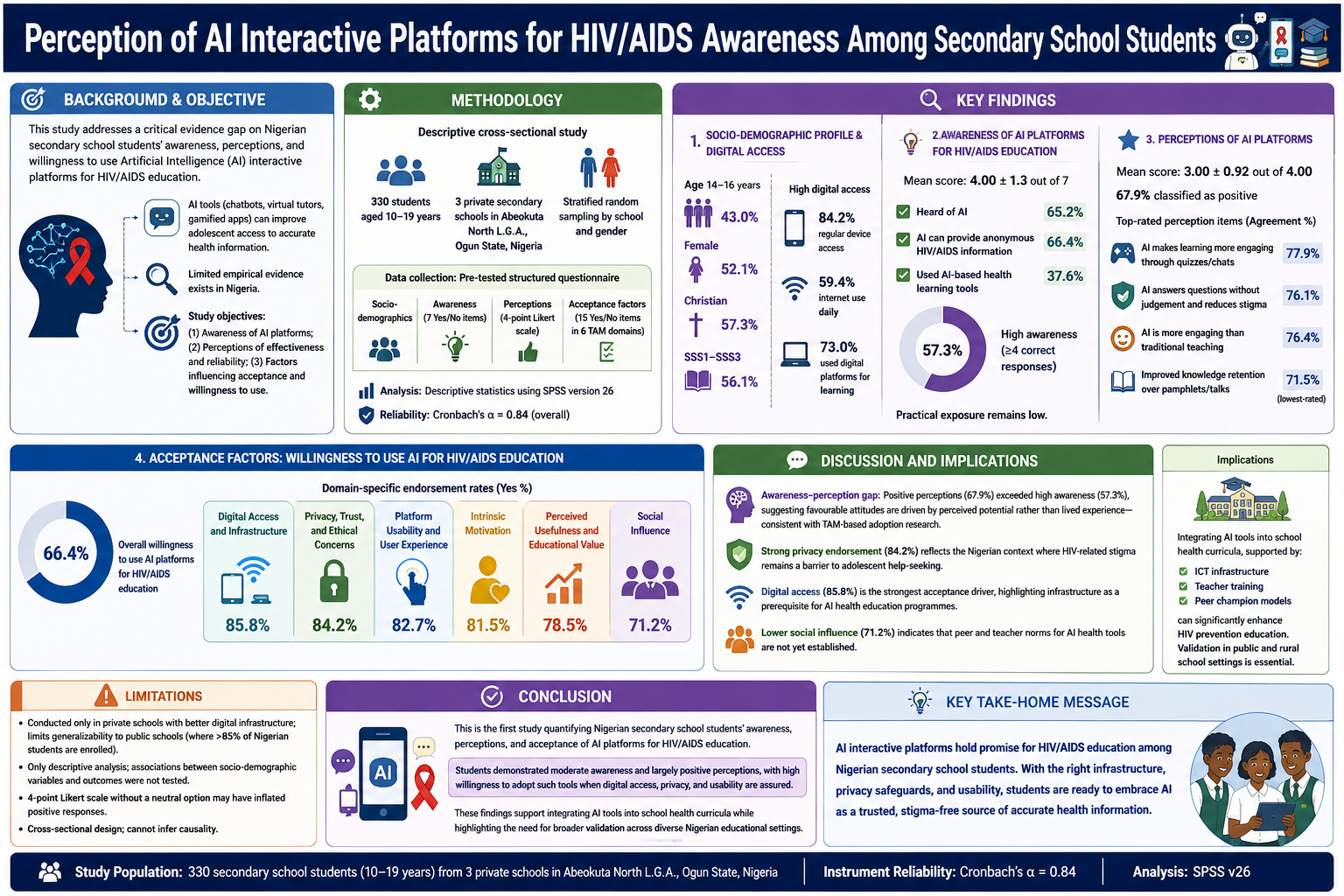
Introduction: Evidence on Nigerian secondary school students' awareness, perceptions, and willingness to use AI interactive platforms for HIV/AIDS education remains limited, despite the promise of these tools for improving adolescents' access to accurate HIV information.
Methods: A descriptive cross-sectional study was conducted among 330 students from three selected private secondary schools in Abeokuta North Local Government Area, Ogun State, Nigeria. Participants were selected using a stratified random sampling technique. Data were collected using a pre-tested structured questionnaire comprising Yes/No items for awareness and acceptance factors, and a 4-point Likert scale (strongly agree, agree, disagree, strongly disagree) for perception, then analysed using descriptive statistics.
Results: Overall awareness was moderate; 189 students (57.3%) demonstrated high awareness (≥4 correct Yes responses out of 7 items, mean = 4.00 ± 1.3), while 215 (65.2%) had heard of AI but only 124 (37.6%) had previously used AI-based tools for health learning. Perceptions were generally positive, with 224 students (67.9%) classified as having favourable views based on composite Likert scores; 257 (77.9%) found AI more engaging, and 251 (76.1%) valued its confidentiality and non-judgemental nature. Acceptance was high (219 students, 66.4%), with digital access (85.8%), privacy and trust (84.2%), and platform usability (82.7%) as the strongest influencing factors.
Conclusion: Students in selected private secondary schools perceived AI platforms positively for HIV/AIDS awareness due to their interactivity and anonymity. Integration of AI tools into school curricula and improved ICT infrastructure are recommended to address gaps in practical exposure and digital access.
Downloads
References
1. Charow R, Jeyakumar T, Younus S, Dolatabadi E, Salhia M, Al-Mouaswas D, et al. Artificial intelligence education programs for health care professionals: a scoping review. JMIR Med Educ. 2021;7(4):e31043. https://doi.org/10.2196/31043
2. Boscardin CK, Gin B, Golde PB, Hauer KE. ChatGPT and generative artificial intelligence for medical education: potential impact and opportunity. Acad Med. 2024;99(1):22-27. https://doi.org/10.1097/ACM.0000000000005439
3. Mir MM, Mir GM, Raina NT, Mir SM, Miskeen E, Alamri MMS, et al. Application of artificial intelligence in medical education: current scenario and future perspectives. J Adv Med Educ Prof. 2023;11(3):133-140.
4. Wang X, He X, Wei J, Liu J, Li Y, Liu X. Application of artificial intelligence to public health education. Front Public Health. 2023;10:1087174. https://doi.org/10.3389/fpubh.2022.1087174
5. Ni Z, Batubara IMS, Bediang G, Yumo H, Zhang X, Oh S, et al. Likelihood of leveraging augmented reality technology to promote HIV prevention and treatment among adolescent girls and young women in Cameroon: cross-sectional survey. JMIR Pediatr Parent. 2025;8(1):e69471. https://doi.org/10.2196/69471
6. Zheng C, Tang Q, Zeng J, Zhong H, Xie H, Ou H. Awareness, knowledge, attitude, and source of information on HIV infection among college students. Risk Manag Healthc Policy. 2025;18:2323-2333. https://doi.org/10.2147/RMHP.S529797
7. Wilder B, Onasch-Vera L, Diguiseppi G, Petering R, Hill C, Yadav A, et al. Clinical trial of an AI-augmented intervention for HIV prevention in youth experiencing homelessness. Proc AAAI Conf Artif Intell. 2021;35(17):14948-14956. https://doi.org/10.1609/aaai.v35i17.17754
8. GSMA. The Mobile Economy Sub-Saharan Africa 2023 [Internet]. London: GSMA Intelligence; 2023 [cited 2026 Jan]. Available from: https://www.gsma.com/mobileeconomy/sub-saharan-africa/
9. Oktavia N, Sondang N, Pramesti AP, Adnani QES, Setyani RA, Susiarno H, et al. The influence of community-level digital health interventions by peer educators on HIV/AIDS prevention among adolescents: a scoping review. World J Adv Res Rev. 2025;25(1):1675-1690. https://doi.org/10.30574/wjarr.2025.25.1.0199
10. Emenike NW, Onukwugha FI, Sarki AM, Smith L. Adolescents' sexual and reproductive health education: perspectives from secondary school teachers in Northern Nigeria. Sex Educ. 2023;23(1):66-80. https://doi.org/10.1080/14681811.2022.2028613
11. Waldmann G, Zippel S, Reinholz M, Fuchs C. From misunderstanding to marginalisation: the role of knowledge in HIV-related discrimination and risk behaviour among adolescents in Germany. AIDS Patient Care STDs. 2025;39(7). doi:10.1089/apc.2025.0050 https://doi.org/10.1089/apc.2025.0050
12. Abiodun O, Olu-Abiodun O, Faturoti A. Charting a New Course for Global South Health Research: Equity, Evidence, and Action. Global South Health Horizons. 2025 Jun 29;1(1):1-7. https://doi.org/10.63950/gshh.2025.1.1.8
13. Edeh NC, Nwaubani OO, Eseadi C, Ogidi CI, Offor CC. Awareness and attitude of senior secondary school students towards HIV/AIDS risk factors and preventive measures in Ebonyi State, Nigeria. Libr Philos Pract. 2021;5368.
14. Ursavaş ÖF. Technology acceptance model: history, theory, and application. In: Ursavaş ÖF, editor. Conducting Technology Acceptance Research in Education. Cham: Springer; 2022. p. 57-91. https://doi.org/10.1007/978-3-031-10846-4_4
15. Al-Emran M, Granić A. Is it still valid or outdated? A bibliometric analysis of the technology acceptance model and its applications from 2010 to 2020. In: Al-Emran M, Shaalan K, Granić A, editors. Recent Advances in Technology Acceptance Models and Theories. Cham: Springer; 2021. p. 1-12. https://doi.org/10.1007/978-3-030-64987-6_1
16. Huang H, Xie M, Yang Z, Wang A. Enhancing HIV cognitive abilities and self-management through information technology-assisted interventions: scoping review. J Med Internet Res. 2025;27:e57363. https://doi.org/10.2196/57363
17. Mulyaningsih EA, Argaheni NB, Juwita S. Leveraging artificial intelligence to address adolescent sexually transmitted infections: a systematic review. Malays J Med Res. 2024;8(3):14-27. https://doi.org/10.31674/mjmr.2024.v08i03.003
18. van Heerden A, Bosman S, Swendeman D, Comulada WS. Chatbots for HIV prevention and care: a narrative review. Curr HIV/AIDS Rep. 2023;20(6):481-486. doi:10.1007/s11904-023-00681-x https://doi.org/10.1007/s11904-023-00681-x
19. Moreno JC, Sanchez-Anguix V, Alberola JM, Julian V, Botti V. An intelligent conversational agent for educating the general public about HIV. Neurocomputing. 2024;563:126902. https://doi.org/10.1016/j.neucom.2023.126902
20. Peng ML, Wickersham JA, Altice FL, Shrestha R, Azwa I, Zhou X, et al. Formative evaluation of the acceptance of HIV prevention artificial intelligence chatbots by men who have sex with men in Malaysia: a focus group study. JMIR Form Res. 2022;6(10):e42055. https://doi.org/10.2196/42055
21. Ezelote CJ, Osuoji NJ, Mbachu AJ, Odinaka CK, Okwuosa OM, Oli CJ, et al. Effect of peer health education intervention on HIV/AIDS knowledge amongst in-school adolescents in secondary schools in Imo State, Nigeria. BMC Public Health. 2024;24(1):1029. https://doi.org/10.1186/s12889-024-18536-4
22. Chizoba AF, Chineke HN, Adogu POU, Nwafia AE, Chizoba CJ. Overview of HIV risk reduction interventions among adolescents - a call to evaluate the HIV education curriculum in Nigeria. Int STD Res Rev. 2020;9(2):57-67. https://doi.org/10.9734/ISRR/2020/v9i230115
23. Kelly AE, Palaniappan S. Using a technology acceptance model to determine factors influencing continued usage of mobile money service transactions in Ghana. J Innov Entrep. 2023;12(1):34. https://doi.org/10.1186/s13731-023-00301-3
24. Mathur S, Eromhonsele AF, Vallarino Z, Savel C, Oche E, Ononye O, et al. "Let's chat!" Piloting a digital chatbot for HIV prevention among cisgender women and transgender men in Nigeria. AIDS Care. 2025;37(6):1015-1025. https://doi.org/10.1080/09540121.2025.2470318
25. Ni Z, Oh S, Saifi R, Azwa I, Altice FL. Evaluating the usability of an HIV prevention artificial intelligence chatbot in Malaysia: a national observational study. JMIR Hum Factors. 2025;12:e70034. https://doi.org/10.2196/70034
26. Liao S, Li J, Liu M, Xie H, Lu Y, Jiang Y. Acceptance and associated factors of HIV testing among college students in China: a systematic review and meta-analysis. PLoS ONE. 2023;18(4):e0284865. https://doi.org/10.1371/journal.pone.0284865
27. Ngcobo S, Mhlongo S, Nkosi B, Mkhize M. Artificial intelligence for HIV care: a global systematic review of current studies and emerging trends. J Int AIDS Soc. 2025;28(Suppl 1):e26468. https://doi.org/10.1002/jia2.70045
28. Olaboye JA, Maha CC, Kolawole TO, Abdul S. Exploring deep learning: preventing HIV through social media data. Int J Appl Res Soc Sci. 2024;6(6):1194-1205.
29. Alie MS, Negesse Y. Machine learning prediction of adolescent HIV testing services in Ethiopia. Front Public Health. 2024;12:1341279. https://doi.org/10.3389/fpubh.2024.1341279
30. Taher R, Syafar HM, Sidin I, Stang, Soedirman O, Russeng SS, et al. Exploration of adolescent knowledge experiences and efforts to identify interventions on the use of digital technology information media to increase knowledge related to HIV/AIDS prevention. Pharmacogn J. 2024;16(5):1150-1158. https://doi.org/10.5530/pj.2024.16.188
Downloads
Published
Data Availability Statement
Available upon request.
Issue
Section
License
Copyright (c) 2026 Ayinde FA, Olu-Abiodun OO

This work is licensed under a Creative Commons Attribution 4.0 International License.