
Fathers' Knowledge of Oral Rehydration Solution in Home Management of Childhood Diarrhoea in a Semi-Urban Nigerian Community
DOI:
https://doi.org/10.63950/gshh.2025.1.2.21Keywords:
Fathers, Home Management of Childhood Diarrhoea, Oral Rehydration SolutionAbstract
Introduction: Extensive research has examined maternal knowledge and practices regarding diarrhoea management and ORS utilisation, whereas the role of fathers has been less explored. This study assessed fathers’ knowledge of the use of ORS in the home management of childhood diarrhoea.
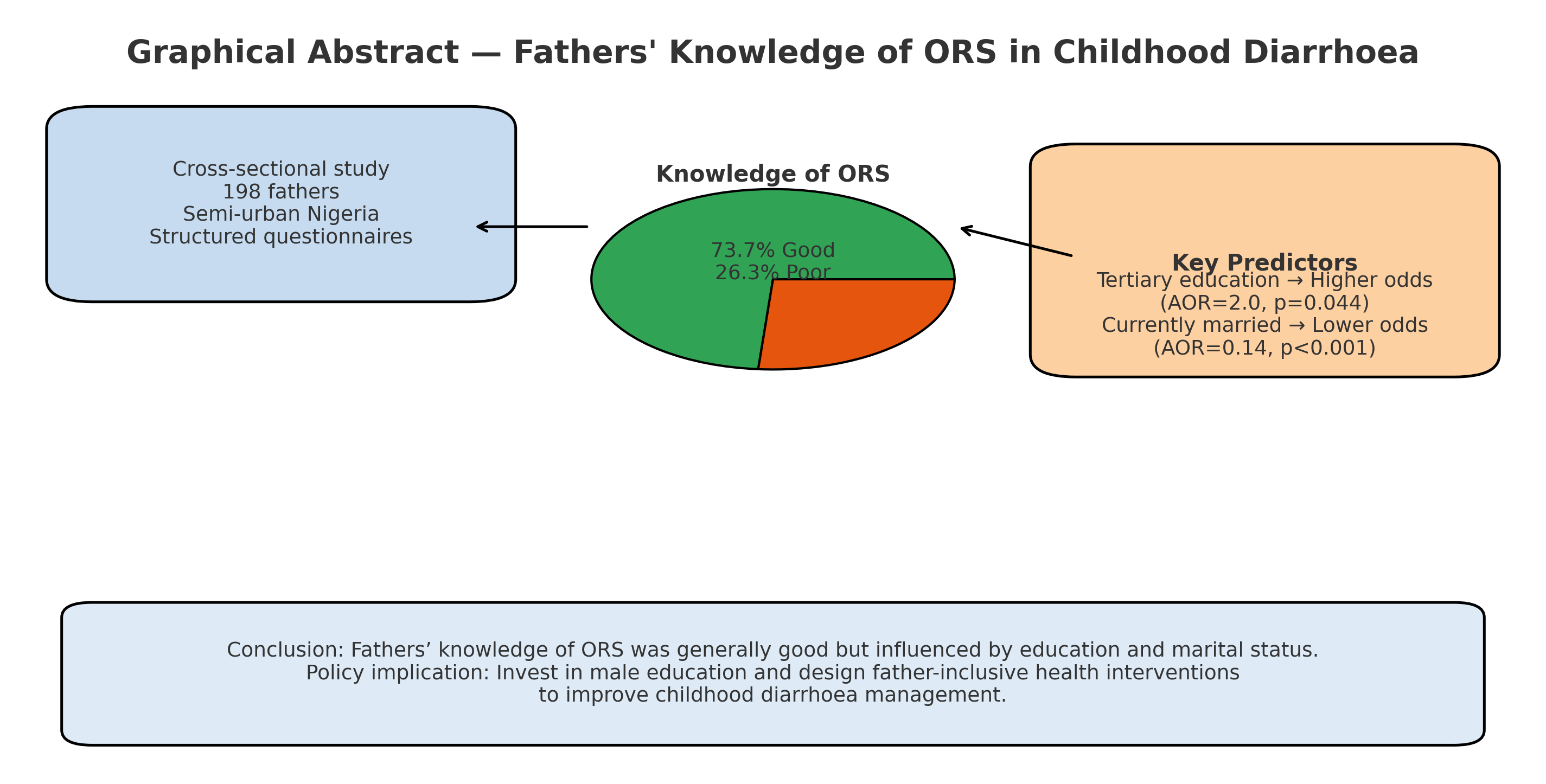
Methods: This is a descriptive cross-sectional study of 198 purposively selected fathers using structured, interviewer-administered questionnaires. Fathers’ knowledge was assessed through the correct identification of certain facts about ORS. The 50% mark was used as the cut-off for good and poor knowledge. Data analysis was conducted using IBM SPSS version 23. Chi-square and Logistic regression analyses were done. A p-value of ≤0.05 was considered statistically significant.
Results: Mean age was 36.7±7.82 years. The majority (73.7%) of the participants had good knowledge of ORS, while 26.3% had poor knowledge. Men who were currently married had 86% lower odds of having good knowledge of ORS compared to men who were not currently married, comprising single, divorced, and widowed men [Adjusted Odds Ratio (AOR) = 0.140; 95% Confidence interval (C.I.) = 0.046-0.422]. Also, men who had up to a tertiary education were twice as likely to have good knowledge of ORS (AOR=2.017; 95% C.I. = 1.019- 3.995).
Conclusion: Fathers' knowledge of ORS was significantly associated with education and marital status. There is a need to invest in male education as a long-term approach to enhance childhood ORS utilisation. There should also be tailored interventions to foster shared responsibility among couples, especially as it relates to childhood diarrhoea management.
Downloads
References
1. UNICEF 2024. Diarrhoea. Available at https://data.unicef.org/topic/child-health/diarrhoeal-disease/#more Accessed on August 2, 2025
2. Aghsaeifard Z, Heidari, G, Alizadeh R. Understanding the use of oral rehydration therapy: A narrative review from clinical practice to main recommendations. Health Sci Rep.2022; 5(5): e27. https://doi.org/10.1002/hsr2.827
3. Munos MK, Walker CLF, Black RE. The effect of oral rehydration solution and recommended home fluids on diarrhoea mortality. Int J Epidemiol.2010; 39(1): i75–i87. https://doi.org/10.1093/ije/dyq025
4. Federal Ministry of Health. (2006). National Programme on Immunization: IPDs Field Guide (3), 1–20.
5. Abdulmalek LJ. Parental factors affecting a child's immunization status in Benghazi, Libya. Libyan J Med Sci. 2017; 1(2):40–42. https://doi.org/10.4103/LJMS.LJMS_16_17
6. Ophori EA, Tula MY, Azih AV, Okojie R, Ikpo PE. Current Trends in Immunization in Nigeria: Prospects and Challenges. Trop Med Health. 2014; 42(2): 67–75. https://doi.org/10.2149/tmh.2013-13
7. Abbas Abid Khazaal, Yousif, M. K., & Mousa, H. A. Mother’s perception toward childhood diarrhea: A cross-sectional study. Med J Babylon. 2022; 19(4): 635–639. https://doi.org/10.4103/mjbl.mjbl_170_22
8. Momoh FE, Olufela OE, Adejimi AA, Roberts AA, Oluwole EO, Ayankogbe OO et al. Mothers’ knowledge, attitude and home management of diarrhoea among children under five years old in Lagos, Nigeria. Afr J Prim Health Care Fam Med.2022; 14(1): e1-e10 https://doi.org/10.4102/phcfm.v14i1.3119
9. Ugboko HU, Nwinyi OC, Oranusi SU, Oyewale JO. Childhood diarrhoeal diseases in developing countries. Heliyon. 2020; 6(4): e03690. https://doi.org/10.1016/j.heliyon.2020.e03690
10. Okafor IP, Akinyemi OT, Wika-Kobani BN, Olubodun T, Eze UT. Childhood diarrhoea: A cross-sectional survey on maternal knowledge, hygienic practices and use of oral zinc for home management in a Nigerian community. Pan Afri Med J. 2022; 42: 123.
11. Stephen N, Kumzhi P, Bulndi LB, Abimiku AD, Gusen NJ, Abeh OS, et al. Knowledge and utilization of oral rehydration therapy among mothers in the management of childhood diarrhoea in General Hospital Kwoi, Kaduna State, Nigeria. Int J Med Health Res. 2016; 2(11): 62-67
12. Oruikor GJ, Durotoye MP. Assessment of Mothers’ Knowledge and use of Oral Rehydration Therapy for Diarrhoea in Children under 5 Years in Ife, Nigeria. Nig Health J. 2023; 23(3): 828-836. https://doi.org/10.60787/tnhj.v23i3.737
13. West BA, Okari TG. Knowledge, attitude, and practice of diarrhoea, home management and prevention among mothers/care-givers attending a paediatric outpatient clinic in Rivers State, Nigeria. Int J Res Rev. 2023; 10(3):544–559. https://doi.org/10.52403/ijrr.20230361
14. Egbewale BE, Karlsson O, Sudfeld CR. Childhood Diarrhea Prevalence and Uptake of Oral Rehydration Solution and Zinc Treatment in Nigeria. Children (Basel). 2022; 9(11):1722. https://doi.org/10.3390/children9111722
15. Aragaw, FM, Ketema DB, Wolde M. Knowledge of ORS packet or pre-packaged liquids and its determinants for the management of diarrhea among women of reproductive age: multilevel analysis of 32 sub-Saharan African countries demographic and health survey. Trop Med Health. 2022; 50: 83. https://doi.org/10.1186/s41182-022-00477-6
16. Duguma NA, Bala ET, Abdisa B, Adula T, Adeba E, Egata G. Caregivers' knowledge, practice, and associated factors toward oral rehydration salt with zinc to treat diarrhea among under 5 children in Burayu town, Oromia, Ethiopia, 2022: Cross-sectional study: An implication for action. Health Sci Rep. 2024;7(1): e1817. https://doi.org/10.1002/hsr2.1817
17. Yimenu DK, Kasahun AE, Chane M, Getachew Y, Manaye B, Kifle ZD. Assessment of knowledge, attitude, and practice of child caregivers towards oral rehydration salt and zinc for the treatment of diarrhea in under 5 children in Gondar town. Clin Epidemiol Global Health. 2022;14: 100998. https://doi.org/10.1016/j.cegh.2022.100998
18. Firima E, Forsberg B. Knowledge and recommendation of oral rehydration solution and zinc for management of childhood diarrhoea among patent and proprietary medicine vendors in Port Harcourt, Nigeria. Journal of Global Health Reports. 2020;4:e2020013. https://doi.org/10.29392/001c.12252
19. Lamberti LM, Fischer Walker CL, Taneja S, Mazumder S, Black RE. The Association between Provider Practice and Knowledge of ORS and Zinc Supplementation for the Treatment of Childhood Diarrhea in Bihar, Gujarat and Uttar Pradesh, India: A Multi-Site Cross-Sectional Study. PLoS One. 2015;10(6):e0130845. https://doi.org/10.1371/journal.pone.0130845
20. Sodeinde KJ, Amoran OE, Abiodun OA. Male Involvement in Birth Preparedness in Ogun State, Nigeria: A Rural/Urban Comparative Cross-sectional Study. African Journal of Reproductive Health June 2020; 24(2):70.
21. Kowalczyk J, Jolly P, Karita E, Nibarere JA, Vyankandondera J, Salihu H. Voluntary Counselling and Testing for HIV among pregnant women presenting in labour in Kigali, Rwanda. J Acquir Immune Def Syndr. 2002;31(4):408-415. https://doi.org/10.1097/00126334- 200212010-00007
22. Lucy IK, Johanne S, Address M, Ellen C. Striving to promote male involvement in maternal health care in rural and urban settings in Malawi- a qualitative study. Reprod Health 2011; 8:36. https://doi.org/10.1186/1742-4755-8-36
23. Kajungu, D., Nabukeera, B., Muhoozi, M. et al. Factors associated with caretakers’ knowledge, attitude, and practices in the management of pneumonia for children aged five years and below in rural Uganda. BMC Health Serv Res. 2023; 23: 700. https://doi.org/10.1186/s12913-023-09713-z
24. Ijadunola MY, Abiona TC, Ijadunola KT, Afolabi OT, Esimai OA, OlaOlorun FM. Male Involvement in Family Planning Decision Making in Ile-Ife, Osun State, Nigeria. Afr J Reprod Health. 2010;14(4):45–52
25. Wondim G, Degu G, Abesha Y, Diress G. Male Involvement in Family Planning Utilization and Associated Factors in Womberma District, Northern Ethiopia: Community-Based Cross-Sectional Study. Open Access J Contracept. 2020; 11:197–207. https://doi.org/10.2147/OAJC.S287159
26. Federal Ministry of Health and Social Welfare, Nigeria. Nigeria Child Survival Action Plan. Abuja: FMoHSW; 2025. Available at https://health.gov.ng/wp-content/uploads/2025/06/FINAL-Nigeria-Child-Survival-Action-Plan.pdf. Accessed on August 28, 2025
27. WHO 2013. The Integrated Global Plan for Prevention and Control of Pneumonia and Diarrhoea (GAPPD). Available at https://www.who.int/publications/i/item/the-integrated-global-action-plan-for-prevention-and-control-of-pneumonia-and-diarrhoea-(gappd). Accessed on August 23, 2025.
Downloads
Published
Data Availability Statement
Data from this work is available from the authors and may be presented on request
Issue
Section
License
Copyright (c) 2025 Sodeinde KJ, Abolurin O, Adefala NO, Omotosho YA, Osinaike AO, Ossai A, Atuk J, Egejuru G, Okereke A, Kuku A (Author)

This work is licensed under a Creative Commons Attribution 4.0 International License.